
Table of Contents
Toggle1. Introduction
In India’s tightly regulated corporate landscape, the phrase “get the right valuation” is more than just good advice; it’s a legal necessity. Whether you’re a startup seeking venture capital, a listed company eyeing a preferential allotment, or an enterprise navigating insolvency, valuations are a critical checkpoint in the process.
But here’s the catch, not all valuation professionals are the same. Two categories dominate the conversation: IBBI Registered Valuers and SEBI Merchant Bankers. Both are authorised to produce valuation reports, yet they operate under different laws, for different purposes, and with different scopes.
Choosing the wrong professional isn’t just a procedural misstep; it can lead to regulatory rejection of your report, delays in fundraising or restructuring, and even non-compliance penalties. For example, using a Merchant Banker’s report where the Companies Act demands a Registered Valuer will get your filing bounced back, no matter how prestigious the banker’s name is, and vice versa.
Understanding the distinction isn’t just an academic exercise; it’s a strategic advantage for business owners, CFOs, compliance teams, and investors who want smooth transactions and bulletproof paperwork.
2. Who Regulates Them and Why It Matters
At the heart of the difference between an IBBI Registered Valuer and a SEBI Merchant Banker is who licenses them and under what law they operate.
- IBBI Registered Valuer → Regulated by the Insolvency and Bankruptcy Board of India (IBBI), their powers come from the Companies (Registered Valuers and Valuation) Rules, 2017 under the Companies Act, 2013, and the Insolvency and Bankruptcy Code, 2016. Their mandate is to carry out valuations explicitly required by law or a regulator in corporate, restructuring, or insolvency contexts.
- SEBI Merchant Banker → Regulated by the Securities and Exchange Board of India (SEBI) under the SEBI (Merchant Bankers) Regulations, 1992. Their core role is capital market transactions and fundraising, but their valuation work is tied to SEBI, RBI, and FEMA compliance, think IPO pricing, preferential allotments, and valuations for cross-border share transfers.
Why does this matter? Because regulators don’t just prefer their own licensed professionals, they require them. If a process is under the Companies Act or IBC, IBBI Registered Valuers are the only legally valid option. If it’s under SEBI or FEMA, Merchant Bankers have the authority.
This regulator-specific mandate means you can’t interchange them without risking non-acceptance of your valuation report. It’s a bit like using a chartered architect’s certificate for a medical fitness test; both are qualified professionals in their own fields, but the regulator wants the right one for the job.
3. IBBI Registered Valuer
An IBBI Registered Valuer is a valuation professional formally recognised under India’s corporate law framework. Their authority comes from the Companies (Registered Valuers and Valuation) Rules, 2017, framed under the Companies Act, 2013, and the Insolvency and Bankruptcy Code, 2016 (IBC). This framework ensures that valuations in legally sensitive contexts are conducted by individuals who have been trained, examined, and licensed specifically for the task.
Regulatory Framework & Legal Basis
- Governed by the Insolvency and Bankruptcy Board of India (IBBI).
- Rules and eligibility criteria are laid out under the Companies (Registered Valuers and Valuation) Rules, 2017.
Their work is also tied to processes under the IBC, 2016, particularly during insolvency resolution and liquidation.
Eligibility Criteria
- Must pass the IBBI Valuation Examination in the relevant asset class (e.g., securities, financial assets, land and building, or plant and machinery).
- Must be a member of a Registered Valuer Organisation (RVO) recognised by IBBI.
Must meet prescribed educational qualifications and relevant professional experience.
Scope of Work
Registered Valuers determine the fair market value of assets for regulatory and compliance purposes. They specialise in specific asset classes, such as:
- Land and building
- Plant and machinery
- Securities and financial assets
Compliance Triggers
Their reports are required in several statutory situations, including:
- Mergers and demergers under the Companies Act.
- Insolvency proceedings before the NCLT.
- Share allotments and corporate restructuring exercises.
- Court-approved schemes and transactions requiring fair value assessment.
Key Attribute
When the law or regulator specifies the need for a “Registered Valuer,” only an IBBI Registered Valuer’s report is legally valid. This makes them indispensable in many compliance-driven corporate processes.
4. SEBI Merchant Banker
A SEBI Merchant Banker is a financial intermediary licensed to manage public issues, capital market transactions, and certain valuation assignments linked to securities and cross-border investments. They operate under the SEBI (Merchant Bankers) Regulations, 1992, which set high standards for capital adequacy, governance, and professional conduct.
Regulatory Framework & Legal Basis
- Governed by the Securities and Exchange Board of India (SEBI).
- Operate under the SEBI (Merchant Bankers) Regulations, 1992.
- Often required to ensure compliance not only with SEBI but also with the Reserve Bank of India (RBI) and the Foreign Exchange Management Act (FEMA) in cross-border transactions.

Eligibility Criteria
- Must be a company (individuals cannot be Merchant Bankers).
- Must meet SEBI’s minimum net worth requirement.
- Must have qualified personnel, adequate infrastructure, and robust compliance systems.
- Must adhere to ongoing reporting and audit requirements.
Scope of Work
Merchant Bankers play a pivotal role in India’s capital markets, with responsibilities that go beyond valuation:
- Managing Initial Public Offerings (IPOs) and Follow-on Public Offerings (FPOs).
- Underwriting securities issues.
- Advising on mergers and acquisitions.
- Providing broader corporate advisory services.
Valuation-Specific Roles
Merchant Bankers are recognised by SEBI, RBI, and FEMA for valuations linked to capital market and cross-border transactions. In such contexts, their reports carry regulatory acceptance and are often mandatory for transaction approval.
Key Attribute
Merchant Bankers are recognised by SEBI, RBI, and FEMA for valuations linked to capital market and cross-border transactions. In such contexts, their reports carry regulatory acceptance and are often mandatory for transaction approval
5. Side-by-Side Comparison Table
The following table summarises the key distinctions between an IBBI Registered Valuer and a SEBI Merchant Banker:
Parameter | IBBI Registered Valuer | SEBI Merchant Banker |
Regulator | Insolvency and Bankruptcy Board of India (IBBI) | Securities and Exchange Board of India (SEBI) |
Main Purpose | Asset valuation for compliance under the Companies Act and the Insolvency and Bankruptcy Code (IBC) | Capital market transactions, fundraising, and related valuations |
Legal Mandate | Companies (Registered Valuers and Valuation) Rules, 2017; Insolvency and Bankruptcy Code, 2016 | SEBI (Merchant Bankers) Regulations, 1992 |
Who Can Register | Individuals or entities meeting eligibility criteria, including passing the valuation exam and RVO membership | Companies meeting SEBI’s net worth, staffing, infrastructure, and compliance requirements |
Valuation Scope | Assets such as land, buildings, plant, machinery, securities, and financial assets | Business and share valuations for IPOs, FDI, preferential allotments, and FEMA compliance |
Compliance Required By | Companies Act, 2013; Insolvency and Bankruptcy Code, 2016 | SEBI, Reserve Bank of India (RBI), Foreign Exchange Management Act (FEMA) |
Example Use Case | Valuation during NCLT-led insolvency proceedings | Pricing of shares for IPO filing with SEBI |
6. When to Use Which?
Selecting the correct professional depends entirely on the regulatory framework governing your transaction.
When to Use an IBBI Registered Valuer
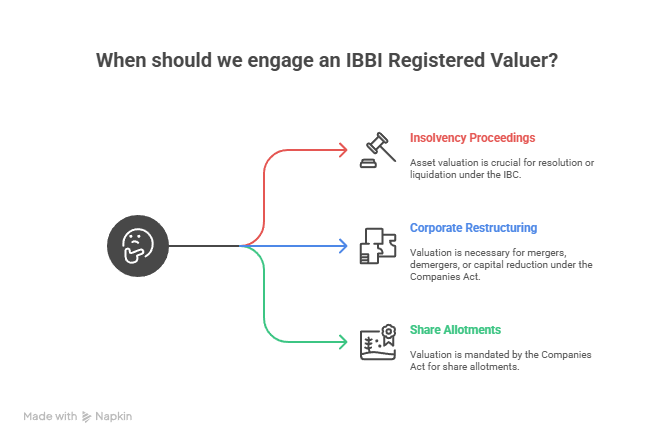
Engage a Registered Valuer when the law explicitly requires it, particularly in:
- Insolvency proceedings under the IBC, where asset valuation is a critical step in resolution or liquidation.
- Corporate restructuring activities such as mergers, demergers, or capital reduction under the Companies Act.
- Share allotments where the Companies Act mandates valuation by a Registered Valuer.
- Court-approved schemes, including amalgamations or arrangements, where compliance with Companies Act provisions is necessary.
A manufacturing company undergoing insolvency proceedings at the National Company Law Tribunal (NCLT) needs to determine the liquidation value of its plant and machinery. In this case, only a Registered Valuer with the relevant asset class approval can provide a legally accepted report.- Insolvency proceedings under the IBC, where asset valuation is a critical step in resolution or liquidation.
When to Use a SEBI Merchant Banker
Appoint a Merchant Banker when the transaction falls within the domain of capital markets or foreign investment regulations, such as:
- Initial Public Offerings (IPOs) and Follow-on Public Offerings (FPOs), where issue pricing and regulatory compliance are mandatory.
- Foreign Direct Investment (FDI) or Overseas Direct Investment (ODI) transactions requiring Fair Market Value (FMV) determination for cross-border share transfers.
Preferential allotments and private placements where SEBI regulations dictate valuation standards.
Example
A technology startup is raising capital from an overseas investor. Since FEMA regulations require a valuation certified by a SEBI-registered Merchant Banker for share pricing, this role becomes essential to ensure the transaction is cleared by both SEBI and the RBI.
7. Recent Regulatory Updates & Trends
The regulatory landscape for valuations in India has seen notable discussion in the last year.
In December 2024, the Securities and Exchange Board of India (SEBI) floated a proposal aimed at restricting Merchant Bankers from undertaking certain valuation assignments. The intention was to enhance independence by shifting specific valuation work, particularly where conflicts of interest could arise, to IBBI Registered Valuers.
By March 2025, however, SEBI decided to defer the proposal, citing the need for further industry consultation. As of August 2025, both Merchant Bankers and Registered Valuers continue to operate in their respective domains without any change in their existing mandates.
That said, the discussion is far from closed. Regulatory shifts in the future could:
- Expand the scope of Registered Valuers in capital market-related valuations.
- Narrow the range of valuation services that Merchant Bankers can provide.
- Require dual sign-off in certain high-value or sensitive transactions.
What Businesses Should Watch For:
Companies, investors, and advisors should keep a close eye on SEBI and IBBI circulars and consultation papers. Changes in permissible roles could have direct implications on transaction timelines, costs, and compliance documentation. Early awareness can prevent last-minute restructuring of advisory teams or redoing valuation reports.
8. Conclusion
While IBBI Registered Valuers and SEBI Merchant Bankers are both recognised valuation professionals in India, their mandates are not interchangeable. Each operates under a distinct regulatory framework, serves different purposes, and produces reports that are valid only within its specific legal context.
Choosing the wrong professional can lead to:
- Regulatory rejection of valuation reports.
- Delays in transaction completion.
- Increased costs due to rework and additional compliance steps.
The right approach is to align your choice of valuer with the exact regulatory requirement governing your transaction, whether that’s under the Companies Act and IBC, or SEBI, FEMA, and RBI guidelines. This decision should be based on compliance and legal acceptance, not simply on familiarity, availability, or cost.
In India’s increasingly regulated environment, getting this distinction right is more than a formality; it’s a safeguard for ensuring smooth, compliant, and timely business transactions.
Frequently Asked Questions (FAQs)
No. Only an IBBI Registered Valuer can issue valuation reports required under the Companies Act, 2013 or the Insolvency and Bankruptcy Code, 2016. Merchant Bankers are not recognised for these purposes unless explicitly permitted by law.
A SEBI-registered Category I Merchant Banker is required for valuations involving capital market transactions — such as IPOs, preferential allotments, rights issues, or pricing of shares for FDI/FEMA compliance. Their reports are legally valid before SEBI and the RBI.
No. Valuations involving cross-border share transfers (between residents and non-residents) must be certified by a Category I Merchant Banker registered with SEBI, as per FEMA (Non-Debt Instruments) Rules, 2019.
They are not interchangeable. Each is regulated under a distinct legal framework — IBBI for Registered Valuers and SEBI for Merchant Bankers. The regulator determines the validity of the report for a given transaction.
Neither is “superior”; validity depends on context.
For Companies Act or IBC compliance → Registered Valuer report.
For SEBI/FEMA/Capital Market transactions → Merchant Banker report.
