
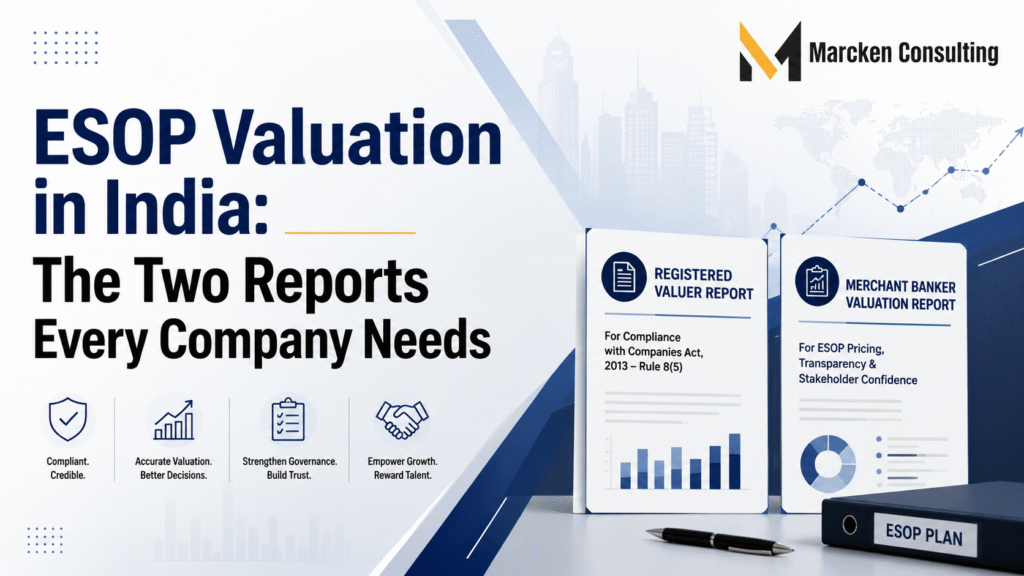
Direct answer: Every company issuing ESOPs in India generally needs two separate valuation reports — an Accounting & Financial Reporting Valuation, which determines the fair value of the stock options for recognising employee compensation expense under Ind AS, and a Statutory, Tax & Share Valuation Report, which determines the fair market value of the underlying shares for perquisite taxation, share allotment and other regulatory purposes. The two reports use different methodologies, apply at different points in the ESOP lifecycle, and cannot substitute for each other.
What Changed on 1 April 2026: From Rule 3 to Rule 15
The mechanics described in this article are settled, but the statutory citations were recodified with effect from 1 April 2026. The Income-tax Act, 2025 replaced the Income-tax Act, 1961, and the Income-tax Rules, 2026 replaced the Income-tax Rules, 1962. Perquisite valuation — previously governed by Rule 3, including Rule 3(8) for listed shares and Rule 3(9) for unlisted shares — now sits in Rule 15 of the Income-tax Rules, 2026. For ESOP shares specifically, the operative provision is Rule 15(6), read with Section 17(1)(d) of the Income-tax Act, 2025 (which replaced the former Section 17(2)(vi) of the 1961 Act); Rule 15(7) covers specified securities that are not equity shares.
The substance is unchanged. On exercise, the fair market value is still the average of the opening and closing market price on the exercise date for listed shares, and for unlisted shares it must still be certified by a SEBI-registered Category I Merchant Banker. The taxable perquisite remains the FMV on exercise less the exercise price, taxed as salary income, with tax deducted at source — the TDS provision formerly at Section 192 of the 1961 Act now corresponds to Section 392 of the 2025 Act. Transactions up to 31 March 2026 continue to be governed by the former Rule 3(8)/3(9).
Throughout this article, the statutory basis for ESOP share FMV is therefore cited as Rule 15 of the Income-tax Rules, 2026, with the earlier Rule 3(8)/3(9) noted where relevant for context.
1. Why ESOP Valuation Is More Important Than Ever
Employee Stock Option Plans (ESOPs) have become one of the most effective tools for attracting, motivating and retaining talent in India. Once associated mainly with technology startups, ESOPs are now used by growth-stage companies, unicorns, listed corporations and increasingly by traditional businesses that want to align employee interests with long-term performance.
Running an ESOP scheme, however, involves more than granting options to employees. Every grant, exercise, allotment and transfer carries accounting, taxation and regulatory implications that must be supported by an accurate valuation. As companies go through audits, fundraising rounds, mergers, acquisitions or public listings, keeping compliant ESOP valuation reports in place becomes increasingly important.
ESOP valuation sits at the centre of this compliance framework. It determines how employee compensation is recognised in the company’s financial statements, how tax is calculated when employees exercise their options, and how shares are valued for regulatory purposes. Without a proper valuation, companies risk inaccurate financial reporting, tax disputes, regulatory scrutiny and avoidable compliance problems.
One of the most common misconceptions among founders and finance teams is that a single ESOP valuation report can satisfy every legal and financial requirement. In practice, that assumption creates compliance gaps. The valuation used for financial reporting measures the fair value of employee compensation; the valuation used for taxation and statutory purposes establishes the market value of shares for regulatory compliance. Because the objectives differ, Indian companies generally need two distinct ESOP valuation reports, each prepared using different methodologies, assumptions and timelines.
2. The Two ESOP Valuation Reports Every Indian Company Needs
Although both reports relate to the same ESOP scheme, they answer entirely different questions and are governed by different regulatory frameworks.
Report 1: Accounting & Financial Reporting Valuation
The first report determines the fair value of employee stock options at the grant date. Its purpose is to calculate the employee compensation expense the company must recognise in its financial statements over the vesting period, in accordance with Ind AS or the applicable Indian GAAP guidance on share-based payments.
To arrive at this fair value, valuation specialists typically use recognised option-pricing models — the Black-Scholes Model for standard ESOPs, or Monte Carlo Simulation for awards with complex market or performance conditions. The report documents assumptions such as expected volatility, expected option life, the risk-free interest rate, dividend yield, exercise price and vesting conditions.
This valuation is used primarily by auditors, finance teams and stakeholders reviewing the company’s financial statements. It ensures the economic cost of granting stock options is accurately reflected in the books.
Report 2: Statutory, Tax & Share Valuation Report
The second report serves a completely different purpose. It supports taxation, share pricing, statutory compliance and regulatory filings whenever employees exercise their options, or shares are issued or transferred.
Unlike the accounting valuation, this report determines the fair market value (FMV) of the company’s shares. It becomes particularly important for calculating the employee’s taxable perquisite at the time of exercise, supporting share allotments, meeting stamp duty requirements, facilitating share transfers and satisfying applicable regulatory obligations.
For unlisted companies, this valuation must be certified by a SEBI-registered Category I Merchant Banker under Rule 15(6) of the Income-tax Rules, 2026 (which, with effect from 1 April 2026, replaced the former Rule 3(9) of the Income-tax Rules, 1962); for listed companies, FMV is the average of the opening and closing market price on the exercise date under the same sub-rule (formerly Rule 3(8)). Where a transaction also requires a Merchant Banker’s certificate, that certificate is issued by a SEBI-registered Category-I Merchant Banker within the same coordinated engagement.
A Quick Comparison
The most important takeaway is that these reports are complementary, not interchangeable. An accounting valuation cannot be used for taxation or statutory compliance, because it measures the fair value of an option as a compensation instrument, not the market value of the underlying share. Equally, a statutory valuation prepared for tax or regulatory purposes does not satisfy accounting standards for recognising employee compensation expense. Relying on one report for both purposes can result in accounting inaccuracies, tax disputes, regulatory objections or additional compliance costs.
3. Why One ESOP Valuation Report Isn’t Enough
At first glance, maintaining two separate valuation reports for the same ESOP scheme may look redundant — both deal with the same stock options. But the underlying objectives, valuation principles and regulatory expectations are fundamentally different, which is why relying on a single report for every purpose creates compliance risk.
Different Objectives
The accounting valuation measures the fair value of the stock option itself on the grant date, so the company can recognise employee compensation expense over the vesting period. The statutory valuation determines the fair market value of the company’s shares at specific points — exercise, allotment or transfer — and forms the basis for tax computation and regulatory compliance. Because the objectives differ, the resulting figures are often different too.
Different Stakeholders
The accounting valuation is reviewed primarily by:
- Auditors
- Finance and accounting teams
- Investors and board members
- Financial statement users
The statutory valuation is relied upon by:
- Income tax authorities
- Regulators, registered valuers and legal advisors
- Company secretaries
- Employees exercising their options
Different Methodologies
For accounting purposes, specialists estimate fair value using option-pricing models such as the Black-Scholes Model, Binomial Models, or Monte Carlo Simulation for complex, market-condition awards. Statutory valuations instead determine the market value of the underlying shares, typically using Discounted Cash Flow (DCF), Comparable Company Multiples, Net Asset Value where applicable, or other accepted techniques. The assumptions and conclusions of the two exercises differ significantly.
Different Timelines
The accounting valuation is prepared on the grant date, since Ind AS requires the fair value of options to be measured when granted; it is updated if the scheme is materially modified, such as through repricing. The statutory valuation is generally required later in the lifecycle — on exercise, allotment, transfer, or when a specific regulatory filing is due. Because these events happen at different stages, one valuation cannot substitute for the other.
The Risk of Using One Report for Every Purpose
Using a single valuation report for accounting, taxation and regulatory compliance may look cost-effective at first, but it usually creates bigger complications later. An accounting valuation built on an option-pricing model will not satisfy what tax authorities or regulators expect from a share FMV report. A statutory FMV report, in turn, does not give finance teams what they need to recognise compensation expense under Ind AS. Maintaining separate reports lets each requirement be addressed with the right methodology, documentation and professional certification, and strengthens the company’s position during audits, tax assessments, due diligence and fundraising.
4. Report #1: Accounting & Financial Reporting Valuation
This report forms the basis for recognising employee stock options as an expense in the company’s financial statements and is a core part of financial reporting under Indian accounting standards. Unlike a business valuation that estimates the value of an entire company, it focuses specifically on the fair value of the stock options granted.
Purpose
When a company grants ESOPs, it provides a form of employee compensation. Even without an immediate cash outflow, accounting standards recognise that granting stock options carries an economic cost. The accounting valuation quantifies this cost by determining the fair value of each option at the grant date, and the resulting compensation expense is recognised over the employee’s vesting period — ensuring the financial statements reflect the true cost of compensating employees through equity rather than cash.
Applicable Accounting Standards
Companies preparing financial statements under Ind AS account for share-based payments in accordance with the applicable guidance on employee share-based compensation. Companies following other Indian GAAP frameworks are similarly expected to recognise ESOP-related expenses using prescribed accounting principles. Regardless of framework, the objective is the same: measure and recognise the fair value of employee stock options consistently and transparently.
Why the Expense Is Spread Over the Vesting Period
Employees usually earn the right to exercise their options only after completing a specified vesting period. Since the benefit is earned over time, the corresponding compensation expense is recognised gradually over that period rather than all at once — matching the expense to the periods in which employees actually provide service.
Who Prepares This Report
Accounting valuations require expertise in both valuation technique and accounting standards. They are generally prepared by valuation specialists, chartered accountants with ESOP valuation experience, actuaries, or independent firms specialising in share-based payments.
When to Obtain It
- At every ESOP grant date
- When existing options are repriced
- When there are significant modifications to vesting conditions or option terms
- Whenever accounting standards require reassessment due to a material change
5. How Accounting ESOP Valuations Are Performed
Determining the fair value of employee stock options is not as simple as comparing the exercise price with the current share price. An ESOP is a financial instrument whose value depends on several variables — the future performance of the company’s shares, the time available before expiry, market volatility, and the conditions attached to the grant. For a step-by-step worked example, see our guide on how ESOP valuation is calculated.
Fair Value vs. Intrinsic Value
Fair value represents the estimated economic value of a stock option at the grant date, factoring in the difference between exercise price and share price as well as expected volatility, time to expiration and market conditions. Intrinsic value, by contrast, is simply the current market price of the share less the exercise price; if the exercise price is higher than the share price, intrinsic value is zero. Fair value is the preferred approach under modern accounting standards, since intrinsic value ignores time value and understates an option’s true economic worth.
Black-Scholes Model
One of the most commonly used methods for valuing standard ESOPs. It assumes the option follows a predictable mathematical framework based on market variables, and suits straightforward grants without complex performance conditions. Its popularity rests on simplicity, wide acceptance and reliable results when appropriate assumptions are used.
Monte Carlo Simulation
Used where the ESOP scheme has market-based performance conditions or other complex features that simpler models cannot capture. It evaluates thousands of possible future scenarios for the share price, giving a more realistic fair value estimate where payouts depend on future market performance or several uncertain variables. It is more computationally intensive but particularly useful for complex share-based compensation.
Key Assumptions
- Expected Volatility — anticipated share-price fluctuations; higher volatility generally increases option value
- Risk-Free Interest Rate — typically benchmarked to government securities
- Dividend Yield — expected dividends reduce future appreciation potential and therefore the option’s fair value
- Expected Life of the Option — longer expected life typically increases value
- Exercise Price — the price employees must pay, central to the valuation
- Vesting Conditions — service, performance or market-based conditions that affect fair value and expense timing
What the Report Includes
- Overview of the ESOP scheme
- Grant details and option terms
- Exercise price, vesting schedule and expiry period
- Selected valuation methodology
- Key assumptions used
- Fair value per option and total compensation expense
- Accounting treatment and impact on financial statements
- Supporting calculations and valuation rationale
6. Report #2: Statutory, Tax & Share Valuation Report
While the accounting valuation determines how ESOPs are reflected in the financial statements, the statutory report establishes the fair market value of the company’s shares for taxation, regulatory compliance and corporate transactions — becoming relevant particularly when employees exercise options or shares are issued, allotted or transferred.
Purpose
The most important function of this report is determining the fair market value (FMV) of shares for calculating the employee’s taxable perquisite at the time of exercise. The difference between the FMV of the shares and the exercise price forms the basis for taxation under the applicable provisions of the Income-tax Act. Beyond taxation, the report also supports:
- Pricing of share allotments
- Valuation for share transfers
- Stamp duty compliance
- Regulatory filings where valuation evidence is required
- Corporate restructuring transactions
- Investment rounds, mergers, acquisitions and employee exits involving ESOP shares
Who Prepares This Report
For unlisted companies, the FMV used for perquisite taxation must be certified by a SEBI-registered Category I Merchant Banker, as required under Rule 15(6) of the Income-tax Rules, 2026 (formerly Rule 3(9) of the Income-tax Rules, 1962). Where a transaction also requires a Merchant Banker’s certificate, that certificate is issued by a SEBI-registered Category-I Merchant Banker within the same coordinated engagement. Depending on the transaction, related valuation work — such as the underlying DCF or business valuation supporting the FMV — may also involve registered valuers, chartered accountants with valuation expertise, or tax advisors, working alongside the certifying Merchant Banker. To work out which credential applies to your transaction, see the difference between an IBBI Registered Valuer and a SEBI Merchant Banker.
When It Is Required
- Employees exercising vested stock options
- Allotment of shares pursuant to ESOP exercise
- Transfer of ESOP shares
- Corporate actions requiring fair market valuation
- Regulatory or tax assessments
- Fundraising, mergers, acquisitions or employee liquidity events involving ESOP shares
Unlike accounting valuations, which are performed at the grant stage, statutory valuations are event-driven and prepared when specific transactions occur.
What the Report Typically Contains
- Purpose of the valuation
- Description of the company and its share capital
- Details of the ESOP transaction
- Valuation methodology adopted
- Fair Market Value (FMV) of the shares
- Supporting assumptions and financial analysis
- Calculation of the employee’s perquisite value, where applicable
- Valuation certificate issued by the authorised professional
- Supporting documentation for regulatory or tax compliance
7. How Statutory ESOP Valuations Are Performed
Statutory ESOP valuations focus on the fair market value (FMV) of the underlying shares, not the value of the option as a compensation instrument. The methodology depends on the company’s stage of growth, whether it is listed or unlisted, the purpose of the valuation, and applicable regulatory requirements.
Determining FMV
FMV represents the price at which shares would change hands between knowledgeable, willing parties in an arm’s length transaction. For listed companies, FMV is the average of the opening and closing price of the share on the recognised stock exchange on the exercise date, under Rule 15(6) of the Income-tax Rules, 2026 (formerly Rule 3(8) of the Income-tax Rules, 1962). For unlisted companies, there is no public market price, so FMV must be established by a SEBI-registered Category I Merchant Banker under the same sub-rule (formerly Rule 3(9)), typically supported by an independent DCF or other business valuation.
Discounted Cash Flow (DCF) Method
One of the most widely accepted approaches for valuing shares of growth-stage and unlisted companies. The valuer projects expected future cash flows and discounts them to present value using an appropriate discount rate, so the valuation reflects the company’s expected earning potential rather than only its historical performance. DCF is particularly useful for startups and high-growth businesses where future growth is a significant driver of value.
Comparable Company Multiples
The valuer compares the company with similar publicly traded or recently transacted businesses in the same industry, using metrics such as revenue, EBITDA, earnings or book value to derive an appropriate multiple. This market-based approach is useful where reliable comparables are available.
Other Accepted Approaches
- Net Asset Value (NAV) approach
- Recent investment transactions
- Comparable transaction analysis
- Hybrid methods combining multiple approaches
Calculating the Perquisite Value
The taxable perquisite at exercise is generally calculated as:
Perquisite Value = Fair Market Value (FMV) of the Share − Exercise Price Paid by the Employee
For example, if the FMV of one share at exercise is Rs 800 and the exercise price under the ESOP is Rs 300, the taxable perquisite is Rs 800 − Rs 300 = Rs 500 per share. This amount generally forms part of the employee’s taxable salary income under the applicable provisions of the Income-tax Act. Although the calculation itself is simple, arriving at the correct FMV usually requires an independent valuation — particularly for unlisted companies where no market price is available.
Why Valuation Certificates Matter
A statutory valuation is more than a numerical exercise — it is documentary evidence supporting the company’s compliance with legal and regulatory requirements. Depending on the transaction, companies may need a valuation certificate to support income tax compliance, share allotment documentation, corporate filings, stamp duty requirements, regulatory inspections, or due diligence during fundraising or acquisitions.
8. Accounting Valuation vs. Statutory Valuation: A Side-by-Side Comparison
An accounting valuation determines how much employee compensation expense should be recognised in the financial statements. A statutory valuation establishes what the company’s shares are worth for tax and regulatory purposes. A Black-Scholes valuation prepared at the grant date cannot be used to determine an employee’s taxable perquisite years later when the options are exercised, and a DCF-based statutory valuation prepared for taxation does not calculate the fair value of the stock options required for financial reporting. Companies therefore maintain both reports, each tailored to its purpose. For a closer look at why the two frameworks can produce different figures, see our guide on the difference between income-tax and Companies Act valuation.
Not sure which report your transaction needs?
The wrong report at the wrong stage is the single most common ESOP compliance gap. A short call will tell you exactly which valuation applies to your grant, exercise or allotment — and when.
9. Understanding the Timeline: When Each ESOP Valuation Is Required
ESOP valuation is not a one-time exercise carried out when a company introduces its scheme. Valuation requirements arise at multiple stages of the ESOP lifecycle, each serving a different accounting, tax or regulatory purpose.
Stage 1: Grant of ESOPs
Companies require an Accounting & Financial Reporting Valuation to determine the fair value of each option. This forms the basis for recognising employee compensation expense over the vesting period and remains the foundation for accounting unless the award is materially modified.
Stage 2: Vesting Period
Companies generally continue recognising the ESOP expense based on the grant-date valuation. A fresh valuation is not usually required during normal vesting, but repricing, changes in vesting conditions, modified performance targets, or cancellation/replacement of awards may require an updated valuation.
Stage 3: Exercise of Options
This is where the Statutory, Tax & Share Valuation Report becomes relevant. At exercise, the company must determine the FMV of its shares to calculate the employee’s taxable perquisite — the market price for listed companies, or an independent valuation for unlisted ones.
Stage 4: Share Allotment
Once employees exercise their options, the company allots shares. Depending on the applicable legal requirements, a statutory valuation may be required to support the allotment process, regulatory filings, or other compliance obligations.
Stage 5: Share Transfer or Liquidity Event
Secondary transactions, buyback programmes, mergers, acquisitions or listings often require updated statutory valuations to determine fair value and support applicable tax and regulatory requirements.
Stage 6: Fundraising, Mergers and Corporate Restructuring
These corporate events may not always require a separate ESOP valuation, but companies often obtain updated statutory valuations so ESOP-related share transactions remain supported by current, defensible reports.
ESOP Valuation Timeline at a Glance
| ESOP Lifecycle Stage | Report Required | Primary Purpose |
|---|---|---|
| 1. Grant of ESOPs | Accounting & Financial Reporting Valuation | Fair value of options for grant-date compensation expense (Ind AS) |
| 2. Vesting Period | Usually none (grant-date basis continues) | Fresh valuation only on repricing or material modification |
| 3. Exercise of Options | Statutory, Tax & Share Valuation | Share FMV for the taxable perquisite (Rule 15(6), IT Rules 2026) |
| 4. Share Allotment | Statutory (where required) | Support allotment pricing and regulatory filings |
| 5. Share Transfer / Liquidity Event | Statutory (updated) | Fair value for secondary sale, buyback, M&A or listing |
| 6. Fundraising / Restructuring | Statutory (as needed) | Keep ESOP-share transactions supported by current reports |
10. Common Mistakes Companies Make with ESOP Valuations
Using One Valuation Report for Every Purpose
The most common mistake is assuming one report can satisfy accounting, taxation and regulatory requirements simultaneously. Since these reports use different methodologies for different purposes, they cannot be used interchangeably.
Ignoring Changes to ESOP Terms
Many companies obtain a valuation at grant but overlook the need for reassessment when the scheme is significantly modified. Repricing, altered vesting schedules or revised performance conditions can affect the accounting treatment and require updated valuations.
Using Unrealistic Valuation Assumptions
Even small changes in assumptions can materially affect the outcome. For accounting valuations, volatility, expected option life, dividend yield and the risk-free rate directly influence fair value; statutory valuations depend on projected cash flows, growth rates, discount rates and market comparables. Assumptions should be reasonable, documented and supported by reliable evidence.
Poor Documentation
Companies should maintain organised records of ESOP scheme documents, board and shareholder approvals, grant letters, employee option registers, valuation reports, financial projections, and supporting assumptions and working papers.
Delaying Valuations Until Compliance Deadlines
Postponing the valuation exercise until an audit or tax assessment is underway often results in incomplete information, rushed assumptions and unnecessary compliance pressure.
Choosing the Wrong Valuation Professional
ESOP valuations combine accounting standards, valuation principles, taxation and corporate law. Engaging professionals without relevant experience increases the risk of non-compliance.
The Cost of Getting It Wrong
- Qualified audit observations
- Tax disputes and reassessments
- Regulatory scrutiny
- Delays during fundraising or due diligence
- Increased compliance costs
- Loss of stakeholder confidence
Free download: ESOP Valuation Compliance Checklist
A one-page checklist covering both reports — grant-date accounting valuation and event-driven statutory valuation — with the documents, approvals and certifications to keep on file for audits, tax assessments and due diligence.
11. Regulatory & Compliance Framework Governing ESOP Valuations in India
ESOP valuation in India sits at the intersection of corporate law, accounting standards, securities regulations and taxation (for the wider map of which report each Indian transaction requires, see our decision guide to valuation reports). Maintaining separate accounting and statutory valuation reports is generally the most effective way to demonstrate compliance across these frameworks.
Companies Act, 2013
Provides the legal framework for issuing ESOPs, including the procedural requirements for approval, administration and issuance — such as board and shareholder approvals. Valuation becomes relevant whenever shares are issued or corporate actions require a fair determination of share value.
Indian Accounting Standards (Ind AS)
For companies following Ind AS, employee stock options are treated as share-based payment transactions. Companies must determine the grant-date fair value of options and recognise the corresponding compensation expense over the vesting period, generally using Black-Scholes or Monte Carlo Simulation.
SEBI Regulations for Listed Companies
Listed companies offering ESOPs must comply with SEBI’s employee benefit regulations, which govern eligibility, disclosures, administration and compliance for listed entities. Even where market prices are readily available, ESOP schemes and disclosures must still align with SEBI’s regulatory expectations. With effect from 2 January 2026, the SEBI (Share Based Employee Benefits and Sweat Equity) (Second Amendment) Regulations, 2025 amended Regulation 34(1) so that valuations required under the SBEB Regulations are carried out by an independent registered valuer — aligned with the definition of “valuer” under Section 247 of the Companies Act, 2013 — rather than a merchant banker; merchant bankers may complete only those assignments already under way before that date, within a nine-month window. This change applies to valuations under the SBEB Regulations and does not affect the separate Merchant Banker certification required for the income-tax perquisite FMV of unlisted shares under Rule 15(6).
Income Tax Considerations
The taxable value of an ESOP at exercise is determined by comparing the fair market value of the shares with the exercise price paid by the employee, under Rule 15(6) of the Income-tax Rules, 2026 (read with Section 17(1)(d) of the Income-tax Act, 2025) — in force from 1 April 2026 and replacing the former Rule 3(8) (listed shares) and Rule 3(9) (unlisted shares) of the Income-tax Rules, 1962. For unlisted companies, this FMV must be certified by a SEBI-registered Category I Merchant Banker. For how the resulting perquisite is taxed in employees’ hands, including the eligible start-up deferral, see our guide on taxes on ESOPs for startups in India. Where a transaction also requires a Merchant Banker’s certificate, that certificate is issued by a SEBI-registered Category-I Merchant Banker within the same coordinated engagement.
Stamp Duty and Corporate Transactions
ESOP shares may also form part of broader corporate transactions — share allotments, transfers, employee liquidity events, mergers, acquisitions or restructuring. Valuation reports support the documentation, stamp duty compliance and due diligence associated with these events.
Why Documentation Matters
- ESOP scheme documents
- Board and shareholder resolutions
- Grant letters and vesting records
- Valuation reports
- Financial projections supporting the valuation
- Working papers and assumptions used by the valuer
- Share allotment and transfer documentation
Well-maintained documentation supports statutory audits and provides valuable evidence during tax assessments, investor due diligence and regulatory inspections.
12. Conclusion: Treat Both Reports as Essential, Not Optional
As ESOPs continue to play a growing role in attracting and retaining talent, companies must recognise that effective ESOP management extends beyond designing an attractive plan. Accurate valuation is equally critical — it is the foundation for sound financial reporting, tax compliance and regulatory governance.
There is no single ESOP valuation report that satisfies every compliance requirement. The Accounting & Financial Reporting Valuation and the Statutory, Tax & Share Valuation Report are designed for different purposes, prepared using different methodologies, and required at different stages of the ESOP lifecycle. The accounting valuation lets companies measure and recognise employee compensation expense under Ind AS; the statutory valuation establishes the fair market value of shares for taxation, regulatory filings, allotments, transfers and other corporate events.
Companies should also remember that ESOP valuation is not a one-time activity completed at grant. New valuation requirements can arise during scheme modifications, option exercises, share allotments, employee exits, fundraising rounds, mergers, acquisitions or other significant corporate events. A structured valuation process keeps a company prepared for these milestones and reduces compliance risk.
Working with experienced valuation professionals is essential. Specialists who understand option-pricing models, business valuation techniques, accounting standards and the Indian regulatory landscape can help ensure that both reports are accurate, well-documented and aligned with their intended purpose.
Frequently Asked Questions
Do I need two ESOP valuation reports, or is one enough?
Most Indian companies need two — an Accounting & Financial Reporting Valuation for Ind AS compensation-expense recognition, and a Statutory, Tax & Share Valuation Report for perquisite taxation and other regulatory events. They measure different things and are not interchangeable.
What is the difference between fair value and fair market value in ESOP valuation?
Fair value is the estimated economic value of the stock option itself at grant, used for accounting. Fair market value (FMV) is the value of the underlying share at a later event such as exercise, used for taxation and statutory compliance.
Which valuation model is used for the accounting ESOP report?
Most standard ESOPs use the Black-Scholes Model. Awards with market-based or complex performance conditions typically use Monte Carlo Simulation.
Who can certify the FMV of ESOP shares for an unlisted company at exercise?
For unlisted companies, Rule 15(6) of the Income-tax Rules, 2026 (which replaced the former Rule 3(9) of the Income-tax Rules, 1962 from 1 April 2026) requires the FMV to be determined by a SEBI-registered Category I Merchant Banker.
When is the accounting ESOP valuation required?
At the grant date, and again if the ESOP scheme is materially modified — for example through repricing or a change in vesting conditions.
When is the statutory ESOP valuation required?
It is event-driven — typically at exercise of options, share allotment, share transfer, or other regulatory and tax events, rather than at grant.
How is the taxable perquisite on ESOP exercise calculated?
Perquisite value equals the Fair Market Value (FMV) of the share on the exercise date less the exercise price paid by the employee. This amount is taxed as part of the employee’s salary income.
Can the accounting valuation be reused for tax purposes?
No. The accounting valuation measures the fair value of the option as a compensation instrument; it does not establish the FMV of the underlying share required for perquisite taxation.
Need help with an ESOP valuation?
Book a no-charge 30-minute consultation to discuss your Accounting or Statutory ESOP valuation requirement.
Book Your Free Consultation Chat with us on WhatsApp
marckenconsulting.com
Marcken Consulting LLP — IBBI-Registered Valuer (Securities or Financial Assets)
Phone: +91 99980 59923 / +91 99985 39902
Email: crm@marckenconsulting.com
