
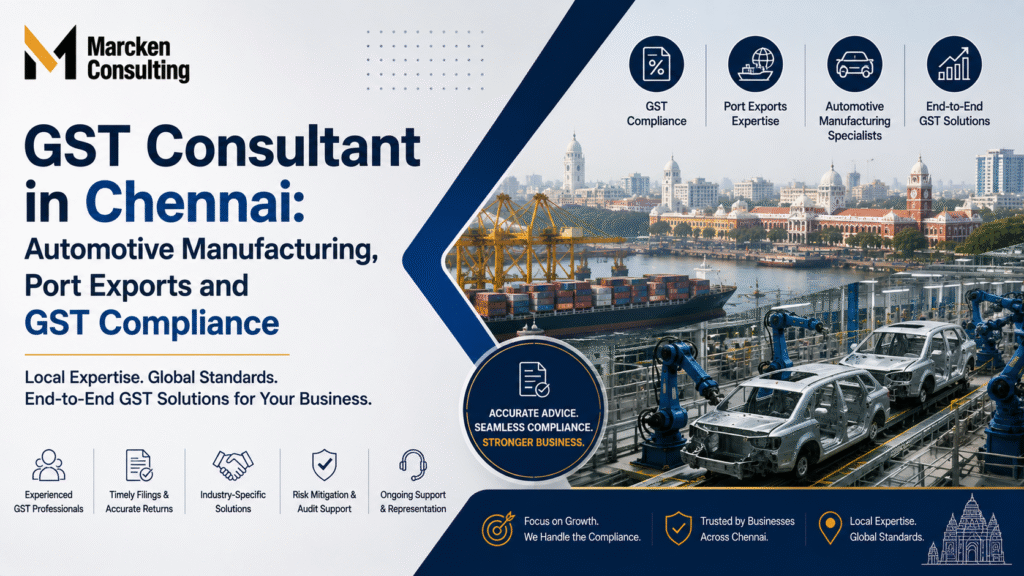
Registration, monthly and annual return filing, input tax credit reconciliation, advisory on classification and place of supply, and representation before GST authorities on notices, audits and appeals — this is the full scope of what a GST consultant in Chennai is expected to cover. Chennai runs on three GST-relevant tracks that rarely overlap elsewhere in India — an automotive and auto-component manufacturing base concentrated along the Sriperumbudur-Oragadam corridor, a working twin-port export gateway at Chennai and Kamarajar (Ennore) Ports, and a growing IT and GCC corridor along OMR — and each throws up GST questions the others rarely encounter.
1. Why Chennai Businesses Need a Dedicated GST Consultant
Chennai’s economy does not reduce to a single template. Ford’s 1995 decision to build its first Indian plant at Maraimalai Nagar is generally credited with turning the city into what is now widely called India’s Detroit — Hyundai, Renault-Nissan and a dense tier of component makers followed over the next three decades, concentrated along the Sriperumbudur-Oragadam industrial corridor. A short distance away, Chennai Port and Kamarajar (Ennore) Port together form one of India’s busiest vehicle- and container-export gateways. And along Old Mahabalipuram Road (OMR), a separate IT, ITES and Global Capability Centre corridor has grown up around Tidel Park since 2000.
An auto-component manufacturer’s GST problems are almost always about job work, capital goods credit and the valuation of parts billed to an OEM parent. A port-facing exporter’s problems are almost always about the LUT-versus-refund route and SEZ registration. An OMR-based GCC’s problems are almost always about export-of-service classification and cross-charge between related entities. For a GST consultant working across Chennai’s economy, spotting which of these three patterns a client actually falls into matters more than running every business through the same generic checklist.
2. GST Jurisdiction in Chennai and Tamil Nadu
The CGST Chennai Zone — formally the GST and Central Excise, Tamil Nadu and Puducherry Zone — is headed by a Principal Chief Commissioner functioning from GST Bhawan, 26/1 Mahatma Gandhi Road, Nungambakkam, Chennai 600034. The Zone comprises 8 executive Commissionerates — Chennai North, Chennai South, Chennai Outer, Trichy, Salem, Madurai, Puducherry and Coimbatore — along with 3 Audit Commissionerates and 3 Appeal Commissionerates handling the first stage of departmental appeal.
Within Chennai city, Chennai North covers Corporation Zones I to IX (wards 1 to 126) and Chennai South covers the remaining Corporation zones across 11 divisions and roughly 55 ranges. Chennai Outer — headquartered separately — covers the surrounding districts of Thiruvallur, Kanchipuram, Vellore, Tiruvannamalai and Villupuram. That last point matters more than it looks: Kanchipuram district is where the Sriperumbudur-Oragadam auto belt sits, so most of Chennai’s automotive manufacturing GST registrations fall under Chennai Outer’s jurisdiction rather than either of the two city-centre Commissionerates.
Tamil Nadu’s state GST administration runs separately through the Commercial Taxes Department, headquartered at Ezhilagam, Chepauk, Chennai 600005 — a different address from the CGST Zone’s Nungambakkam headquarters, and the office a business deals with for state-side scrutiny and assessment.
Appeals now have a dedicated second-appeal forum: the GST Appellate Tribunal’s Chennai Bench became operational on 1 April 2026, hearing appeals from taxpayers across Tamil Nadu and Puducherry.
3. GST Registration for Chennai Businesses
3.1 Who Must Register
Section 22 of the CGST Act, 2017 sets the baseline: once aggregate turnover in a financial year exceeds Rs 40 lakh for a goods supplier or Rs 20 lakh for a services supplier, registration becomes mandatory. Tamil Nadu is a normal-category state, so both standard thresholds apply in full. Section 24 separately makes registration compulsory regardless of turnover for certain categories — inter-state suppliers, e-commerce operators and sellers, persons paying tax under reverse charge, casual taxable persons, among others — overriding the Section 22 threshold test wherever it applies. That matters immediately for an ancillary unit in Oragadam supplying an OEM across state lines, since inter-state supply triggers registration regardless of turnover.
3.2 Documents Required
- Proprietorship — PAN, Aadhaar, business address proof, bank account details
- Partnership firm — partnership deed, PAN of the firm and partners, address proof
- LLP — LLP agreement, Certificate of Incorporation, DIN/DPIN of designated partners
- Private limited company — Certificate of Incorporation, MOA/AOA, board resolution authorising the signatory, director details
- Exporting business (automotive, components or otherwise) — the above documents for the relevant constitution, plus Import Export Code (IEC), where goods are exported
3.3 Composition Scheme
Section 10 of the CGST Act lets a registered person with aggregate turnover up to Rs 1.5 crore in the preceding financial year opt for a flat 1% (traders and manufacturers) or 5% (restaurant services) rate instead of regular slab rates; Section 10(2A) offers service providers with turnover up to Rs 50 lakh a 6% variant. Composition dealers cannot claim input tax credit and cannot make inter-state outward supplies — a real constraint for smaller ancillary units that sell mainly within Tamil Nadu but occasionally ship a consignment to an OEM’s plant in another state.
3.4 Biometric Authentication
Under Rule 8(4A) of the CGST Rules, 2017, applicants selected on a risk basis must complete Aadhaar-linked biometric authentication and in-person document verification at a designated GST Suvidha Kendra before an Application Reference Number is generated, booked through the GST registration portal.
4. Returns and the Compliance Calendar
The standard monthly cycle runs GSTR-1 (outward supplies) and GSTR-3B (summary return and payment), followed by GSTR-9 (annual return) once the year closes and GSTR-9C above the applicable turnover threshold. Composition dealers follow a lighter cycle — CMP-08 quarterly, GSTR-4 annually — and businesses with turnover up to Rs 5 crore in the preceding year can opt into the Quarterly Return Monthly Payment (QRMP) scheme instead of filing monthly. Across every turnover band, the single biggest generator of GST notices stays the same: input tax credit claimed in GSTR-3B not matching, supplier-wise, what actually shows up in GSTR-2B — a particular risk for auto-component manufacturers reconciling credit across dozens of tier-2 and tier-3 suppliers.
Goods movement carries its own compliance layer. A valid e-way bill is mandatory under Rule 138 of the CGST Rules for most inter-state consignments above the prescribed value — a routine requirement for any Oragadam unit shipping components to an OEM’s assembly line in another state, or moving finished vehicles to Chennai Port for export.
5. GST for Automotive Manufacturing: The Sriperumbudur-Oragadam Belt
5.1 The Cluster
The Sriperumbudur-Oragadam belt is anchored by the SIPCOT Oragadam Industrial Complex, a state-developed zone in Kanchipuram district sitting at the junction of NH4 (toward Bengaluru) and NH45 (toward Tiruchirappalli). Hyundai Motor India runs one of its largest production bases in Sriperumbudur, Renault Nissan Automotive India operates its plant at Oragadam, and Daimler India Commercial Vehicles, Royal Enfield and India Yamaha Motor all run full-scale production alongside a dense tier of component makers, including Bosch India, Apollo Tyres and Delphi-TVS Diesel Systems. As covered in Section 2, this belt sits within Kanchipuram district and therefore under Chennai Outer Commissionerate’s jurisdiction for CGST purposes, not either of the city-centre Commissionerates.
5.2 GST 2.0 and the Vehicle Rate Reset
The GST Council’s rate rationalisation effective 22 September 2025 replaced the earlier 28% GST plus compensation cess — which took the effective rate on larger vehicles up to around 45-50% — with two flat rates: 18% for small cars (broadly, sub-4-metre vehicles with petrol engines up to 1200cc or diesel engines up to 1500cc) and for commercial vehicles, and 40% for larger cars, SUVs and other vehicles outside the small-car definition, with compensation cess discontinued on these categories. Electric vehicles continue at a concessional 5%. For OEMs running high-volume lines in Sriperumbudur and Oragadam, this reset has meant reworking dealer pricing, revisiting past ITC positions built around the old cess structure, and in some cases renegotiating vendor contracts priced on the earlier effective rate.
5.3 Job Work and Auto-Component GST
Much of the Oragadam belt operates as a job-work and ancillary-supply economy feeding a handful of OEM assembly lines. Section 143 of the CGST Act allows a principal manufacturer to send inputs to a job worker without payment of tax, provided the inputs are received back — or supplied further from the job worker’s premises — within 1 year, and capital goods within 3 years, beyond which the movement is deemed a supply and tax becomes payable. Where a component maker sells finished parts to a related OEM at a price that does not reflect open-market value, Rule 28 of the CGST Rules governs the valuation of that related-party supply, and getting this wrong is a recurring theme in departmental scrutiny of ancillary units clustered around a small number of anchor customers.
5.4 A Live Example: Ford’s Maraimalai Nagar Restart
Ford’s Maraimalai Nagar plant, dormant since production wound down in 2021, illustrates the kind of question a reactivating manufacturing unit runs into. Under a memorandum of understanding signed with the Tamil Nadu government in October 2025, the plant is being retooled as an export-only engine manufacturing facility rather than resuming car production for the domestic market, with production expected to begin around 2029-30. A unit restarting on this basis has to work through capital goods ITC on the retooling investment, whether output will be entirely export-oriented — with the LUT and refund questions covered in Section 6 — and how a multi-year gap in production affects existing registration and compliance history, the kind of transition-specific advisory a generic compliance checklist does not anticipate.
6. GST for Port-Led Exports: Chennai Port, Kamarajar Port and MEPZ
6.1 The Twin-Port Complex
Chennai Port and Kamarajar Port — formerly Ennore Port, about 20 km north of the city and India’s first corporate port — together form one of India’s busiest vehicle-export gateways. In FY26, Chennai Port exported more than 2.04 lakh vehicles, up 11.5% on the previous year, while Kamarajar Port handled a further 1.91 lakh automobile exports; combined cargo throughput across the two ports reached a record 106.98 million tonnes for the year. For an OEM or component exporter in Sriperumbudur or Oragadam, which port a consignment routes through, and the vessel booking lead times involved, is a logistics decision with a GST documentation trail attached at every step.
6.2 Export Documentation
Exports of goods are zero-rated under Section 16 of the IGST Act, generally executed against a Letter of Undertaking rather than paying IGST and claiming a refund afterward. Where a business does pay IGST and claims a refund instead, Section 54 of the CGST Act sets a 2-year limitation period from the relevant date, and Section 54(6) allows 90% of the claimed amount to be refunded provisionally within 7 days of acknowledgment, pending final verification.
6.3 MEPZ and the SEZ Route
Businesses wanting a formal export-processing structure rather than routing everything through LUT-based zero-rating have the option of the Madras Export Processing Zone at Tambaram — one of India’s earliest SEZs, established in 1984 and converted from export-processing-zone to full SEZ status in January 2003. Spread over roughly 262 acres and covering automotive components, electronics, engineering and IT among other sectors, MEPZ is currently undergoing a major redevelopment aimed at multiplying its export value several times over. An SEZ unit requires separate GST registration under the second proviso to Section 25(1) of the CGST Act (inserted by the CGST Amendment Act, 2018, effective 1 February 2019), and zero-rating on supplies to an SEZ unit has been restricted to authorised operations only since Notification 27/2023-Central Tax, effective 1 October 2023 — a distinction worth checking before assuming every SEZ-bound supply is automatically zero-rated.
Need help with GST registration, returns, advisory, or a notice that needs a response?
A 30-minute conversation is usually enough to scope the work. There is no charge and no obligation.
7. GST for the OMR IT, ITES and GCC Corridor
7.1 Export of Services
Section 2(6) of the IGST Act sets a five-part test for a supply to qualify as an export of service, and all five must be satisfied together: the supplier sits in India, the recipient sits outside India, the place of supply falls outside India, payment arrives in convertible foreign exchange (or Indian Rupees where the RBI permits it), and the supplier and recipient are not simply two establishments of the same distinct person. (We’ve written separately about the place-of-supply rules for exporters of services.) Chennai’s OMR corridor — built up around Tidel Park since 2000 and now home to a mix of IT services firms and Global Capability Centres spanning BFSI, IT and automotive R&D — runs into this test constantly, particularly the last condition, since a GCC and its foreign parent can be treated under the IGST Act as establishments of a single distinct person. Many of these GCCs also run equity compensation programmes for their India-based teams, a compliance track of its own — see our ESOP Consultant in Chennai guide for that side of it.
7.2 The Section 13(8)(b) Omission
Intermediary services — arranging or facilitating a supply between two other parties rather than supplying the underlying service directly — used to have their place of supply fixed at the supplier’s location in India under Section 13(8)(b) of the IGST Act, regardless of where the recipient was based, which denied export treatment even when the client and payment were entirely offshore. Section 157 of the Finance Act, 2026 (Presidential assent 30 March 2026) has now omitted Section 13(8)(b) altogether, so intermediary services fall back on the default place-of-supply rule in Section 13(2), which looks to the recipient’s location instead.
7.3 Cross-Charge and ISD
Since 1 April 2025, Input Service Distributor registration has been mandatory for passing on credit on common input services procured from outside vendors across an entity’s multiple registrations, while cross-charge under Schedule I of the CGST Act, valued per Rule 28, remains the applicable route for services generated in-house and recharged to a related entity or head office.
8. GST Advisory: Classification, RCM, ITC and Refunds
8.1 Classification and Rate Advisory
HSN/SAC classification determines the applicable rate — a question that matters as much for a component maker billing multiple part numbers to an OEM as for an exporter classifying a shipment for customs. This is reviewed at onboarding and again whenever the product or service mix changes.
8.2 Reverse Charge Mechanism
Reverse charge shifts tax liability onto the recipient for a defined set of inward supplies — legal services from an advocate, goods transport agency services (a routine cost for any manufacturer moving components or finished vehicles), a director’s services to their own company, among others — discharged in cash, separate from whatever credit the business claims on its outward supplies.
8.3 Input Tax Credit Eligibility
A defined list of inward supplies is permanently blocked from input tax credit under Section 17(5) of the CGST Act — motor vehicles (with some exceptions), food and beverages, works contract services on immovable property (also with exceptions), among other categories. This list gets tested often on manufacturing sites with an active capex programme, where distinguishing eligible plant and machinery from blocked categories is not always straightforward.
8.4 Refunds
Refund advisory covers exports made under LUT, inverted-duty-structure refunds where relevant, and excess balance in the electronic cash ledger. A fuller picture of how these advisory engagements are structured is on our GST Advisory Services page.
9. GST Notices, Audits and Appeals
9.1 Common Notice Types
The notices that land most often on Chennai businesses’ desks are ASMT-10 scrutiny notices flagging return discrepancies, DRC-01A intimations giving advance notice of a proposed demand, Section 65 audit notices, and proceedings brought under the newer Section 74A framework.
9.2 Responding to a Notice
Whatever the notice type, the reply has to address the specific discrepancy raised — backed by reconciliation working and supporting documents — and land within the timeframe given. Our fuller guide on responding to a GST notice, including current appeal timelines, covers this in more depth.
9.3 Audit Support
Section 65 departmental audits require at least 15 working days’ prior notice in Form GST ADT-01, and the department is expected to complete the audit within 3 months of starting it, extendable by the Commissioner by up to a further 6 months. A Section 66 special audit works differently — carried out by a Chartered Accountant or Cost Accountant nominated by the Commissioner, on a 90-to-180-day timeline.
9.4 Appeals
Where an assessment or demand order is contested, the first appeal lies to the jurisdictional Appellate Authority within the CGST Chennai Zone, and a further appeal lies to the GST Appellate Tribunal’s Chennai Bench, operational since 1 April 2026 for taxpayers across Tamil Nadu and Puducherry. Appeal timelines and pre-deposit requirements are covered in our notices and appeals guide.
10. What to Look for in a GST Consultant in Chennai
- Chartered Accountant-led, not just a filing intermediary. A portal agent can handle registration and return filing, but advisory judgment — on classification, job-work valuation, export treatment, SEZ registration — and representation before GST authorities calls for a qualified professional who can be held to a standard of care.
- Relevant sector exposure. The job-work and capital-goods questions facing an Oragadam component maker have little in common with the export-of-service questions an OMR GCC runs into. A consultant who has genuinely worked across manufacturing, port-led export and services is far more likely to catch a risk a generalist would miss.
- Advisory and litigation support under one roof. Firms that only file returns tend to outsource notice responses and appeals elsewhere; when both functions sit in-house, issues surface earlier because the same team is reconciling the credit and later defending it if challenged.
- Clear scope and turnaround times. Before engaging, ask exactly what falls inside a monthly retainer versus what gets billed separately, and how quickly to expect a response once a notice actually lands.
11. How Marcken Consulting Supports GST Compliance in Chennai
Marcken Consulting is a Chartered Accountancy and valuation firm serving Chennai clients across automotive manufacturing, port-led export businesses and the city’s IT and GCC base. The full scope described above — registration, monthly and annual return filing, input tax credit reconciliation, advisory on classification, job work and export treatment, and representation on notices, audits and appeals — falls within our GST practice. Where a matter calls for a Merchant Banker’s certificate alongside GST or valuation work, that certificate is issued by a SEBI-registered Category-I Merchant Banker within the same coordinated engagement.
Businesses working through GST-adjacent statutory requirements in Chennai may also find our companion guide relevant: ESOP Consultant in Chennai, covering equity compensation for the city’s manufacturing and technology businesses.
Frequently Asked Questions
Who needs GST registration in Chennai?
Under Section 22 of the CGST Act, any supplier crossing Rs 40 lakh turnover (goods) or Rs 20 lakh (services) in a financial year. Section 24 separately makes registration compulsory regardless of turnover for certain categories, including inter-state suppliers and e-commerce sellers.
Which GST Commissionerate covers the Sriperumbudur-Oragadam auto belt?
Chennai Outer Commissionerate, which covers Kanchipuram district along with Thiruvallur, Vellore, Tiruvannamalai and Villupuram — distinct from Chennai North and Chennai South, which cover the city’s own Corporation wards.
What GST rate applies to cars manufactured in Chennai after GST 2.0?
Following the rate rationalisation effective 22 September 2025, small cars (broadly sub-4-metre, within specified engine capacity limits) attract 18%, larger cars and SUVs attract 40%, and electric vehicles continue at a concessional 5%, with compensation cess discontinued on these categories.
Does a component supplier need separate registration to sell into an SEZ like MEPZ?
Supplies into an SEZ can be zero-rated, but the SEZ unit itself requires separate registration under the second proviso to Section 25(1) of the CGST Act, and since Notification 27/2023-Central Tax, zero-rating is limited to authorised operations rather than every supply made to the SEZ unit.
Where do I appeal a GST order if I am registered in Chennai?
The first appeal goes to the jurisdictional Appellate Authority within the CGST Chennai Zone. A further appeal goes to the GST Appellate Tribunal’s Chennai Bench, operational since 1 April 2026, which hears appeals for Tamil Nadu and Puducherry.
How much does a GST consultant charge in Chennai?
It depends on scope — a one-off registration, ongoing monthly compliance, or advisory and litigation support — and on transaction volume. We don’t publish a standard fee card; pricing follows a short scoping conversation about the specific business.
Can a GST consultant represent me before the GST department?
Yes — a Chartered Accountant can be formally authorised to represent a taxpayer through scrutiny, audit and appellate proceedings before GST authorities, including drafting and filing the actual response or appeal.
Speak to Us
If you need GST support in Chennai — registration, return filing, advisory, or a notice that needs a response — we offer a no-charge 30-minute consultation with no obligation.
Marcken Consulting LLP | CA Murli Chandak — IBBI-Registered Valuer (Securities or Financial Assets)
Website: marckenconsulting.com
Phone: +91 99980 59923 / +91 99985 39902
Email: crm@marckenconsulting.com
