
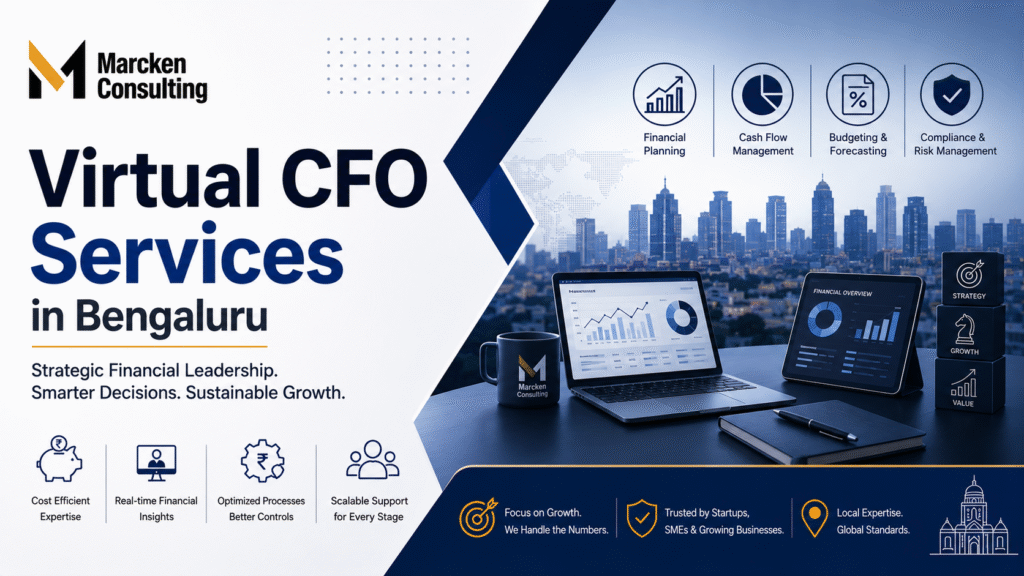
Marcken Consulting LLP provides Virtual CFO services to businesses in Bengaluru across all sectors — manufacturing and engineering, technology and services, global capability centres, healthcare and biotech, real estate, retail and consumer, and funded startups. Monthly management reporting, cash flow control, compliance oversight, fundraising support and statutory valuation, led by qualified Chartered Accountants. Book a no-charge 30-minute consultation.
1. When a business needs more than an accountant
Most businesses reach the same point. The books are maintained, the audit is completed, the returns are filed. But month to month, the picture is unclear:
- Revenue is growing, yet nobody can say confidently which product, division or customer is actually profitable.
- Cash tightens without warning, and payments are managed by instinct rather than a forecast.
- A lender or an investor asks for financials and projections, and it takes weeks to assemble them.
- There are several group entities and no consolidated view of the whole.
- Compliance is handled, but reactively, close to each due date.
- Hiring a full-time CFO is either unaffordable or premature.
An accountant records what has happened. A Virtual CFO interprets it, forecasts what is coming, and advises on the decisions that follow. That is the gap this engagement fills.
Under Section 203 of the Companies Act, 2013, only certain classes of companies (based on paid-up capital thresholds) are required to appoint a whole-time CFO. Most growing private companies fall outside that mandatory requirement, which is precisely why a Virtual CFO engagement is both compliant and commercially sensible at this stage.
2. Sectors we work with in Bengaluru
Bengaluru’s business base is unusually broad, and the financial priorities differ markedly by sector.
- Manufacturing and engineering — costing accuracy, inventory and working capital control, capex appraisal and plant-level profitability
- Technology and IT services — project and client profitability, revenue recognition, utilisation and multi-currency receivables
- Global capability centres and Indian subsidiaries — group reporting alignment, transfer pricing coordination, statutory compliance and governance
- Healthcare, pharma and biotech — long development cycles, grant and milestone accounting, regulatory capex planning
- Real estate and construction — project-wise costing, milestone revenue recognition, funding and cash flow phasing
- Retail, consumer and D2C — channel-wise margin analysis, marketplace reconciliation, inventory and returns
- Garments and textiles — order costing, export documentation, working capital cycles
- Professional services and education — recurring revenue tracking, receivables discipline, capacity planning
- Funded startups — covered separately at section 4
3. What the engagement covers
3.1 Monthly
- Management information pack — profit and loss, balance sheet and cash flow, with written commentary on what moved and why
- Cash flow monitoring and rolling forecast — expected inflows and outflows, so pressure points are visible before they arrive
- Receivables and payables review — ageing analysis, collection priorities and working capital impact
- Budget versus actual analysis — variance explained line by line
- Statutory compliance tracking — GST, TDS, ROC and income tax obligations monitored and reported, including AOC-4, MGT-7 and DIR-3 KYC filings with the MCA and ITR filings with the Income Tax Department
- Monthly review call with promoters or management
3.2 Periodic and transaction-driven
- Annual budgeting and rolling forecasts
- Financial projections and business plans
- Fundraising and lender support — investor materials, data room preparation, facility applications and covenant monitoring in line with RBI lending norms
- Valuation support — share valuation, ESOP valuation and floor price determination
- Internal financial controls and process design
- Consolidated reporting across group entities
4. Additional scope for funded companies
Where a company has raised institutional capital, or expects to, the reporting requirement changes. The following sit alongside the monthly scope at section 3.1:
- Investor-format reporting with the metrics your investors actually ask for
- Burn and runway tracking — gross and net burn, runway in months, and the sensitivities that change it
- Board pack support ahead of each board meeting
- Cap table maintenance — reconciled to statutory registers, with dilution modelling across scenarios
- ESOP scheme administration — grant records, vesting schedules, exercise tracking and accounting
- Round readiness — data room preparation and due diligence coordination. See also our note on what founders should fix before a valuation
Not sure whether a Virtual CFO is right for your business yet?
A 30-minute conversation is usually enough to tell. We will look at how you currently report and tell you honestly whether this would add value at your stage, or whether it is premature. No charge, no obligation.
5. Why Marcken Consulting
5.1 Valuation handled within the engagement
This is the part most Virtual CFO providers cannot offer. Marcken Consulting LLP is an IBBI-Registered Valuer (Securities or Financial Assets). A growing company encounters several distinct valuation requirements, each with its own statutory basis:
- Preferential allotment of shares — under Section 62(1)(c) of the Companies Act, 2013 read with Rule 13 of the Companies (Share Capital and Debentures) Rules, 2014
- Private placement — under Section 42 read with Rule 14 of the Companies (Prospectus and Allotment of Securities) Rules, 2014
- ESOP perquisite valuation on exercise — the fair market value determination under Rule 3(8) and Rule 3(9) of the Income-tax Rules, which requires a Category-I Merchant Banker
- Transfer of unquoted shares — floor price determination for secondary transactions
Where a transaction also requires a Merchant Banker’s certificate, that certificate is issued by a SEBI-registered Category-I Merchant Banker within the same coordinated engagement.
The practical benefit is sequencing. When the valuation and the monthly reporting sit with one team, a transaction does not stall while an external valuer is briefed from the beginning.
5.2 Qualified professionals, directly accessible
Engagements are led by qualified Chartered Accountants. You deal with the professionals doing the work, not an account manager.
5.3 Compliance is core practice, not an add-on
The firm’s regular work includes GST compliance and advisory, concurrent audit and statutory certification. Compliance oversight within a Virtual CFO engagement draws on work the team performs daily.
6. How the engagement works
Step 1 — Initial discussion. A no-charge 30-minute call to understand the business, the current finance setup and what is missing.
Step 2 — Scope proposal. A written proposal setting out which deliverables apply, the reporting calendar and the fee.
Step 3 — Onboarding. Access to books and records, a review of the current position, and agreement on reporting formats.
Step 4 — Monthly cycle. Reporting pack delivered on an agreed date each month, followed by the review call.
Fees depend on the scope agreed, business size and transaction volume. We quote a fixed monthly retainer after the initial discussion, with no variable billing.
7. Working with Bengaluru businesses remotely
Marcken Consulting operates from Ahmedabad and serves clients across India, including Bengaluru and Karnataka. Virtual CFO delivery is digital by nature — reporting, review calls and document exchange all happen online. Where a matter warrants an in-person meeting, it can be arranged. This applies equally to businesses across Bengaluru, including those based in Koramangala, Indiranagar, HSR Layout, Whitefield and Electronic City.
8. Frequently asked questions
How is a Virtual CFO different from our accountant?
An accountant records and reports what has happened. A Virtual CFO interprets it, forecasts what is coming, and advises on the decisions that follow.
Do you only work with startups?
No. We work across manufacturing, technology, healthcare, real estate, retail, professional services and other sectors, as well as funded startups. Section 4 sets out the additional scope that applies where a company has raised institutional capital.
We have several group entities. Can you handle that?
Yes. Consolidated reporting across related entities is a common requirement and is scoped into the engagement.
Can you also carry out our share valuation?
Yes. As an IBBI-Registered Valuer (Securities or Financial Assets), share valuation, ESOP valuation and floor price determination are handled within the same engagement.
Do you have an office in Bengaluru?
No. We operate from Ahmedabad and serve Bengaluru clients remotely, which is how Virtual CFO work is delivered in any event.
What does it cost?
Fees depend on the agreed scope, business size and transaction volume. We quote a fixed monthly retainer after an initial discussion.
9. Related reading
Virtual CFO services in other cities we serve:
- Virtual CFO Services in Mumbai
- Virtual CFO Services in Ahmedabad
- Virtual CFO Services in Delhi
- Virtual CFO Services in Chennai
- What Is a Virtual CFO? Roles, Benefits, and Costs
- Virtual CFO vs Fractional CFO: Key Differences & Which to Choose
- Best CA in Bengaluru: How to Choose the Right Firm
10. Speak to us
If you would like to discuss whether a Virtual CFO engagement suits your business, we offer a no-charge 30-minute consultation with no obligation.
Marcken Consulting LLP — IBBI-Registered Valuer (Securities or Financial Assets)
Website: marckenconsulting.com
Phone: +91 99980 59923 / +91 99985 39902
Email: crm@marckenconsulting.com
