
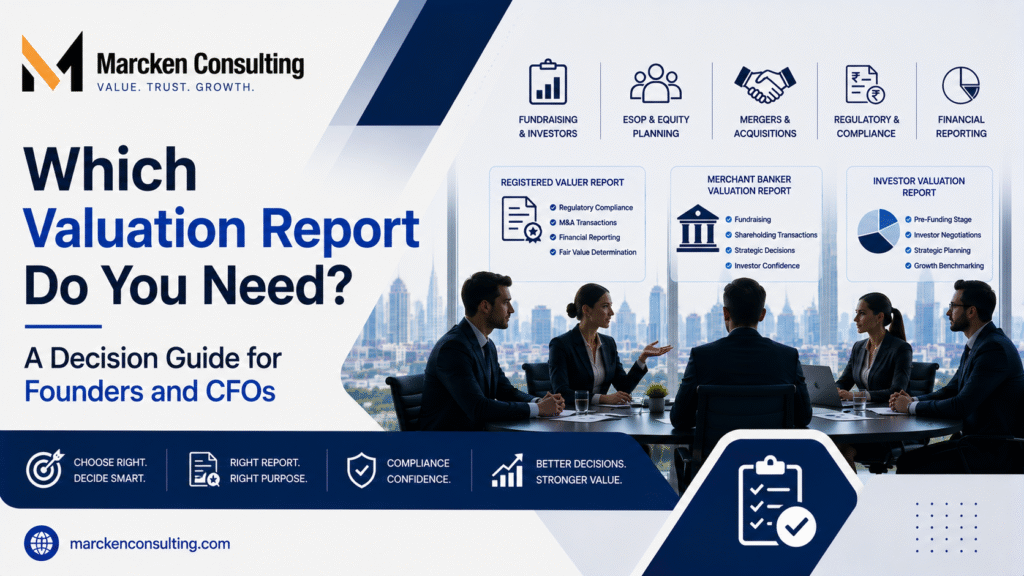
Prepared by Marcken Consulting | July 2026
Which Valuation Report Do You Need? A Decision Guide for Founders and CFOs
Table of Contents
- Introduction: Stop Asking “Do I Need a Valuation Report?”
- The Short Answer: You Don’t Need a Valuation Report — You Need the Right One
- What Are You Trying to Achieve?
- Which Law Governs Your Transaction?
- FEMA Valuation Report: When Foreign Investors Are Involved
- Companies Act Valuation Report: Corporate Actions, ESOPs and Business Restructuring
- Income Tax Valuation Report: Avoiding Tax Surprises
- SEBI and IBC Valuation Reports: Special Situations Every CFO Should Know
- Stage-by-Stage Guide: Which Valuation Report Does Your Startup Actually Need?
- The Decision Matrix: Which Valuation Report Should You Choose?
- Understanding the Valuation Methodologies Behind These Reports
- Five Costly Valuation Mistakes Founders Keep Making
- A Simple Decision Checklist Before You Engage a Valuer
- Final Thoughts: The Right Report Can Save More Than Compliance
- Frequently Asked Questions
1. Introduction: Stop Asking “Do I Need a Valuation Report?”
For many founders and CFOs, the question “which valuation report do I need” usually comes up at critical moments — raising capital, issuing ESOPs, bringing in a foreign investor, restructuring the company, or facilitating a founder exit. The instinct is understandable: get a valuation report, satisfy the requirement, and move on.
The reality, however, is far more nuanced.
There is no single valuation report that serves every business transaction. A valuation prepared for a foreign investment round cannot necessarily be used for an ESOP plan. Likewise, a report prepared for tax purposes may not satisfy the requirements of the Companies Act or FEMA. Each regulatory framework in India has its own objective, valuation principles, prescribed methodologies, and authorised professionals who can certify the valuation.
This often leads to confusion. Two companies at similar stages may require entirely different valuation reports simply because the purpose of the transaction, the parties involved, or the governing law is different. Even the same company may require multiple valuation reports within a single funding round if different regulatory requirements come into play.
Choosing the wrong report can have consequences that extend well beyond compliance. It may delay fundraising, trigger regulatory objections, create tax exposures, complicate share issuances, or require costly rework at a later stage. Conversely, selecting the appropriate valuation report from the outset streamlines transactions, provides regulatory comfort to stakeholders, and strengthens confidence among investors, auditors, and boards.
This guide has been prepared to help founders and CFOs navigate that decision with clarity. Rather than focusing solely on valuation methodologies, it explains which valuation report is required, when it is required, and why. By the end of this guide, you should be able to identify the appropriate valuation report for your specific transaction, understand the legal framework behind it, and engage the right valuation professional with confidence.
2. The Short Answer: You Don’t Need a Valuation Report — You Need the Right One
If there is one key takeaway from this guide, it is this: unlike financial statements, which are prepared using a common accounting framework, valuation reports are purpose-specific. Indian laws regulate valuations based on the nature of the transaction, the stakeholders involved, and the underlying regulatory objective. As a result, there is no universal report that satisfies every legal or commercial requirement.
In practice, determining the correct valuation report comes down to answering three straightforward questions.
2.1 Why is the valuation required?
The purpose of the transaction is the single biggest factor in determining the type of valuation report required. A company raising equity from foreign investors is subject to different regulatory requirements than a company issuing ESOPs, undertaking a merger, or facilitating a secondary sale of shares.
Some of the most common scenarios include:
- Raising capital from foreign investors (FDI)
- Raising funds from domestic investors such as angel investors, venture capital funds, or family offices
- Issuing ESOPs or sweat equity to employees
- Undertaking mergers, demergers, or corporate restructurings
- Facilitating founder, investor, or employee share transfers
- Preparing for an IPO or other SEBI-regulated transactions
- Complying with income tax provisions for share transfers
- Insolvency, liquidation, or resolution proceedings
Each of these transactions has its own valuation requirements and may require a different type of report.
2.2 Who are the parties involved?
The identity of the parties is equally important. For example, a transaction involving a non-resident investor immediately brings the Foreign Exchange Management Act (FEMA) into consideration. On the other hand, a transaction exclusively between resident shareholders may instead be governed primarily by the Companies Act or the Income Tax Act.
Similarly, whether the company is listed or unlisted, whether the investor is an Alternative Investment Fund (AIF), or whether the transaction involves employees, promoters, or third-party investors can significantly influence the applicable valuation framework.
2.3 Which law governs the transaction?
Finally, every valuation must satisfy the legal framework applicable to that specific transaction. Depending on the circumstances, the governing law may be:
- FEMA, for cross-border investments and transfers involving non-residents
- The Companies Act, 2013, for corporate actions such as preferential allotments, mergers, buybacks, and ESOP-related matters
- The Income Tax Act, 1961, for determining fair market value in secondary transactions and other tax-related situations
- SEBI Regulations, for listed companies, IPOs, and valuation of investment portfolios held by Alternative Investment Funds
- The Insolvency and Bankruptcy Code (IBC), 2016, for valuation during corporate insolvency resolution and liquidation proceedings
Each law prescribes its own compliance requirements, valuation methodologies, and eligible certifying professionals. A report that is perfectly acceptable under one law may not satisfy another.
2.4 Think of it as a decision framework
Instead of beginning with the question “which valuation report should I obtain,” founders and CFOs should approach the process by asking three questions in sequence: why am I undertaking this transaction, who are the parties involved, and which law governs this transaction. The answers will naturally determine the valuation report, methodology, and professional required.
The remainder of this guide follows this exact framework. We first examine how the purpose of a transaction influences the valuation requirement, then map the relevant regulatory framework, and finally provide practical guidance for common startup and corporate scenarios — from early-stage fundraising and ESOPs to mergers, secondary transactions, and cross-border investments.
3. What Are You Trying to Achieve?
Before discussing laws, valuation methodologies, or regulatory compliance, it is important to answer one fundamental question: what is the purpose of the valuation?
This is the starting point for every valuation engagement. Contrary to popular belief, valuation is not a one-size-fits-all exercise. The same company may have different values assigned to it under different regulatory frameworks — not because the business itself has changed, but because each framework is designed to achieve a different objective.
For example, a valuation prepared to determine the minimum issue price for foreign investors under FEMA serves a different purpose from one prepared to establish the fair market value of shares for employee stock options. Likewise, a valuation supporting a merger under the Companies Act follows a different regulatory intent than one prepared for income tax compliance in a secondary share transfer.
Understanding the commercial objective behind the transaction is therefore the first and most important step in selecting the appropriate valuation report. Below are some of the most common situations where founders and CFOs encounter valuation requirements.
3.1 Raising capital from foreign investors
Cross-border fundraising is one of the most common reasons startups require a valuation — see our comprehensive fundraising valuation guide for the full picture. Whenever equity shares, CCPS, or CCDs are issued to a non-resident investor, FEMA regulations prescribe minimum pricing requirements that must be supported by a compliant valuation. In these situations, the valuation is intended to ensure that Indian companies do not issue shares below their fair value, thereby safeguarding foreign exchange regulations.
3.2 Raising capital from domestic investors
Fundraising from resident angel investors, venture capital funds, or family offices generally offers greater commercial flexibility than cross-border transactions. However, depending on how the transaction is structured — such as through preferential allotments or private placements — statutory valuation requirements under the Companies Act may still arise. Although investors often negotiate valuations commercially, companies should always evaluate whether any legal provisions require an independent valuation report.
3.3 Issuing ESOPs or sweat equity
Employee ownership has become an essential component of startup compensation strategies. However, determining the exercise price of ESOPs is not as simple as using the company’s latest funding valuation. ESOPs require an independent assessment of the fair market value of ordinary equity, taking into account factors such as minority interest, liquidity, and employee taxation. Similarly, issuing sweat equity also involves statutory valuation requirements under the Companies Act.
3.4 Mergers, demergers and corporate restructuring
Business combinations, restructurings, and schemes of arrangement require valuations that go beyond determining a share price. They establish fair exchange ratios between merging entities, protect shareholder interests, and provide courts and regulators with an objective basis for approving the transaction. In these cases, valuation becomes a key component of corporate governance rather than merely a pricing exercise.
3.5 Secondary share transfers
Founders, early employees, and investors frequently sell shares during later funding rounds or structured liquidity events. While these transactions may appear commercially straightforward, they often trigger valuation requirements under both FEMA and the Income Tax Act. Depending on whether resident or non-resident parties are involved, the transaction may require multiple valuation reports to satisfy different regulatory objectives.
3.6 Preparing for an IPO or listed company transactions
As companies mature, valuations become increasingly important for IPO preparations, preferential issues, related-party transactions, and regulatory disclosures under SEBI regulations. Institutional investors, merchant bankers, auditors, and regulators all rely on robust valuation frameworks during this phase of a company’s lifecycle.
3.7 Income tax planning and compliance
Not every valuation is driven by fundraising or corporate actions. In many situations, companies require valuations to support fair market value under the Income Tax Act, particularly during off-market transfers, internal restructuring, or transactions involving closely held shares. A well-prepared valuation report can significantly reduce the risk of future tax disputes and litigation.
3.8 Insolvency and distressed situations
When companies enter financial distress, valuation serves a very different purpose. Instead of determining investment value, it helps establish fair value and liquidation value for lenders, insolvency professionals, and resolution applicants under the Insolvency and Bankruptcy Code. Although relatively niche compared to fundraising valuations, these reports become critical during corporate restructuring and insolvency proceedings.
3.9 One company, multiple valuation reports
Perhaps the most important takeaway for founders and CFOs is that the same business can legitimately require multiple valuation reports within a short period of time. Consider a growth-stage startup that is simultaneously raising capital from an overseas venture capital fund, expanding its ESOP pool, and allowing an early investor to partially exit through a secondary sale. Despite involving the same company and the same underlying business fundamentals, each transaction serves a different purpose and may therefore require separate valuation reports under different laws.
Rather than asking “what is my company’s valuation,” the better question is: which valuation report does this specific transaction require? Answering that question correctly is the first step toward regulatory compliance and efficient deal execution.
4. Which Law Governs Your Transaction?
Once the purpose of the transaction is clear, the next step is identifying the legal framework that governs it.
This is where many founders become confused. They assume that obtaining any professionally prepared valuation report will satisfy every regulatory requirement. In reality, valuation in India is governed by multiple independent statutes, each designed to address a different policy objective. A valuation prepared under one law does not automatically fulfil the requirements of another.
For example, a report prepared to comply with FEMA pricing regulations may not be sufficient for a merger under the Companies Act. Similarly, a valuation prepared for income tax purposes cannot necessarily be relied upon for an ESOP issuance or a preferential allotment. Understanding the applicable law is therefore just as important as understanding the transaction itself.
Broadly, most startup and corporate valuation engagements in India fall under one of the following regulatory frameworks.
4.1 Foreign Exchange Management Act (FEMA)
FEMA governs transactions involving persons resident outside India. Whenever shares or convertible securities are issued to, or transferred between, resident and non-resident parties, pricing guidelines prescribed under the FEMA Non-Debt Instruments Rules become applicable. The primary objective is to ensure that cross-border transactions occur at a fair value that complies with India’s foreign exchange regulations.
Typical transactions include:
- Foreign Direct Investment (FDI)
- Cross-border share transfers
- Issue of CCPS or CCDs to overseas investors
- Conversion of convertible instruments involving non-residents
4.2 Companies Act, 2013
The Companies Act governs several corporate actions that require an independent valuation from an IBBI-registered valuer. Unlike FEMA, which focuses primarily on pricing in cross-border transactions, the Companies Act seeks to ensure fairness, transparency, and protection of stakeholder interests during significant corporate decisions.
Common examples include:
- Preferential allotments
- Private placements
- ESOP valuations
- Sweat equity
- Buybacks
- Mergers and demergers
- Schemes of arrangement
4.3 Income Tax Act, 1961
The Income Tax Act introduces valuation requirements primarily to determine the fair market value of shares for taxation purposes. The objective is not to facilitate investment but to prevent tax avoidance through transactions executed at artificially high or low prices.
Valuation reports under Rule 11UA frequently become relevant during:
- Founder exits
- Employee share sales
- Investor secondary transactions
- Off-market transfers
- Capital gains assessments
- Determination of deemed consideration
As tax provisions continue to evolve, founders should ensure that valuation assumptions align with the latest regulatory position.
4.4 SEBI Regulations
Although many early-stage startups may have limited interaction with SEBI regulations, they become increasingly relevant as companies scale. SEBI’s valuation framework applies across several situations, including:
- Listed company transactions
- Initial Public Offerings (IPOs)
- Alternative Investment Funds (AIFs)
- Portfolio valuation of unlisted investments
- Fairness opinions in regulated transactions
Companies preparing for public markets should familiarise themselves with these requirements well in advance.
4.5 Insolvency and Bankruptcy Code (IBC)
For companies undergoing insolvency proceedings, valuation plays an entirely different role. Instead of determining investment value, valuations are used to establish fair value and liquidation value of the corporate debtor, enabling creditors and resolution professionals to evaluate competing resolution plans objectively. Although relatively specialised, these reports are essential components of India’s insolvency framework.
4.6 Different laws, different objectives
One reason valuation appears complicated is that every regulator asks a different question. FEMA asks whether shares are being issued or transferred at a compliant price in cross-border transactions. The Companies Act asks whether corporate actions are fair to shareholders and stakeholders. The Income Tax Act asks whether the transaction reflects an appropriate fair market value for taxation purposes. SEBI focuses on investor protection, market transparency, and disclosure. IBC seeks to establish fair and liquidation values for distressed businesses.
Because the objectives differ, the valuation methodologies, reporting formats, and eligible certifying professionals may also differ. This is why two valuation reports prepared on the same date for the same company can legitimately arrive at different conclusions while both remaining fully compliant with their respective legal frameworks.
5. FEMA Valuation Report: When Foreign Investors Are Involved
If your company is raising capital from an overseas investor or facilitating a share transfer involving a non-resident, FEMA (Foreign Exchange Management Act) is likely to be the first regulatory framework you need to consider.
Cross-border investments into India are governed by the Foreign Exchange Management (Non-Debt Instruments) Rules, 2019 (NDI Rules). These rules regulate the pricing of equity instruments issued or transferred between residents and non-residents to ensure that foreign exchange transactions are conducted at fair value. For startups and growing businesses seeking international capital, the FEMA valuation report is often one of the earliest statutory valuation reports they encounter.
5.1 When does a FEMA valuation report apply?
A FEMA valuation becomes relevant whenever equity instruments are issued or transferred in a transaction involving a person resident outside India. Some of the most common scenarios include:
- Issuing equity shares to foreign investors under an FDI round
- Issuing Compulsorily Convertible Preference Shares (CCPS)
- Issuing Compulsorily Convertible Debentures (CCDs)
- Secondary sale of shares between a resident and a non-resident
- Conversion of convertible securities where a non-resident is involved
Whether the investor is an overseas venture capital fund, an angel investor, a foreign corporate, or an individual residing outside India, FEMA pricing guidelines must generally be considered before the transaction is completed.
5.2 What does the law say?
Rule 21 of the Foreign Exchange Management (Non-Debt Instruments) Rules, 2019 requires that equity instruments issued to a person resident outside India must be priced at or above their fair value. The fair value must be determined using an internationally accepted pricing methodology on an arm’s length basis and certified by an eligible professional. This requirement protects both India’s foreign exchange framework and the integrity of cross-border transactions by ensuring that shares are not issued to non-residents at artificially low prices.
5.3 Who can issue a FEMA valuation report?
Depending on the nature of the transaction and the applicable regulations, the valuation may generally be certified by a Chartered Accountant, a SEBI-registered Merchant Banker, or a practising Cost Accountant. Companies should always consult their legal advisors to confirm the appropriate certifying professional for the specific transaction, particularly in complex cross-border structures.
5.4 Which valuation methodologies are commonly used?
The regulations refer to internationally accepted pricing methodologies, allowing the methodology to be selected based on the nature and stage of the business.
Discounted Cash Flow (DCF)
Widely used for venture-backed startups and growth companies with credible financial projections. Future cash flows are estimated and discounted to arrive at the present value of the business.
Comparable Company Analysis (CCA)
Suitable where sufficient market comparables exist. The business is valued by benchmarking it against similar listed or recently transacted companies using valuation multiples.
Net Asset Value (NAV)
Typically used for asset-intensive businesses, investment holding companies, or entities where tangible assets form the primary source of value.
The choice of methodology depends on factors such as the company’s stage of growth, availability of financial forecasts, industry characteristics, and nature of assets.
5.5 Why is the FEMA valuation so important?
One of the most common misconceptions among founders is that the FEMA valuation determines the “market valuation” of the company. In reality, its primary purpose is regulatory compliance. The certified fair value establishes the minimum issue price for equity instruments issued to non-residents.
This means shares cannot be issued below the certified fair value, but companies are free to issue shares above the certified value if commercial negotiations justify a higher price.
For example, suppose a FEMA valuation determines the fair value of a share to be ₹120. If investors agree to subscribe at ₹150, the transaction remains compliant because the issue price exceeds the regulatory floor. However, issuing shares at ₹100 would generally result in a FEMA contravention, irrespective of mutual agreement between the company and the investor.
This distinction is critical. The FEMA valuation is not a ceiling or a negotiated valuation — it establishes the minimum permissible price under Indian foreign exchange regulations.
5.6 Practical situations where founders encounter FEMA valuations
- Seed and Series A funding rounds involving foreign investors
- Investments by overseas venture capital funds
- Strategic investments by foreign corporations
- Cross-border founder or investor exits
- Conversion of CCPS or CCDs into equity
- Share transfers between resident and non-resident shareholders
Obtaining the valuation early in the transaction process helps avoid regulatory delays, ensures pricing compliance, and provides confidence to investors, legal advisors, and authorised dealer banks involved in the transaction.
6. Companies Act Valuation Report: Corporate Actions, ESOPs and Business Restructuring
While FEMA primarily governs cross-border investments, many purely domestic corporate actions are regulated by the Companies Act, 2013. Whenever the law requires an independent assessment of value to protect shareholder interests, maintain transparency, or support significant corporate decisions, the Companies Act prescribes valuation by a Registered Valuer. For many companies, this becomes the most frequently used statutory valuation framework throughout their lifecycle.
6.1 When does the Companies Act require a valuation?
The Companies Act mandates or contemplates valuation across several important corporate actions, including:
- Preferential allotment of shares
- Private placement transactions where valuation is required as part of the transaction structure
- Issue of sweat equity shares
- Shares issued for consideration other than cash
- Buyback of shares
- Mergers and demergers
- Schemes of arrangement
- Certain ESOP-related valuations
In each of these situations, the objective is to ensure that shareholders and stakeholders are treated fairly and that significant corporate actions are supported by an independent valuation.
6.2 Who can certify a Companies Act valuation?
Section 247 of the Companies Act, read with the Companies (Registered Valuers and Valuation) Rules, 2017, provides that valuations for specified purposes must be carried out by an IBBI-registered valuer possessing the relevant asset class registration. For valuation of shares and financial instruments, this generally means a Registered Valuer registered under the asset class of Securities or Financial Assets — see our guide to Registered Valuers in India for the full asset-class breakdown. The introduction of the Registered Valuer framework has significantly strengthened consistency, independence, and accountability in statutory valuations across India.
6.3 Common corporate actions requiring an IBBI Registered Valuer
Preferential allotments
Preferential allotments are made under Section 62(1)(c) of the Companies Act, 2013, read with Rule 13 of the Companies (Share Capital and Debentures) Rules, 2014. When shares are issued to selected investors rather than existing shareholders, valuation supports the pricing of the issue and demonstrates fairness to stakeholders.
Private placements
Private placements are governed by Section 42 of the Companies Act, 2013, read with Rule 14 of the Companies (Prospectus and Allotment of Securities) Rules, 2014. Many private placement transactions, particularly those involving negotiated structures or statutory approvals, rely on an independent valuation to support the proposed issue price and regulatory documentation.
Sweat equity
Sweat equity represents shares issued in exchange for know-how, intellectual property, or value addition rather than cash consideration. Since these transactions involve non-cash consideration, an independent valuation is necessary to establish both the value of the shares and the value of the underlying contribution.
Mergers and demergers
Business combinations require careful determination of the fair value of each participating entity so that exchange ratios can be established on an equitable basis. The valuation report forms an important part of the documentation placed before shareholders, creditors, and the National Company Law Tribunal (NCLT).
Buybacks
Independent valuation supports pricing decisions during buyback transactions, particularly where shareholder fairness and regulatory compliance are critical.
6.4 ESOP valuation: a separate valuation exercise
One of the most misunderstood areas of startup valuation relates to Employee Stock Option Plans (ESOPs). Many founders assume that the valuation agreed during the latest funding round should automatically become the exercise price for employee stock options. In practice, this approach is often inappropriate. See our detailed guide to ESOP scheme design and valuation for a full walkthrough.
The price negotiated with institutional investors typically reflects factors such as liquidation preferences, investor rights, information access, and negotiated commercial terms. Employees, on the other hand, receive ordinary equity with different rights and significantly lower liquidity. Consequently, the Fair Market Value (FMV) used for ESOPs is frequently lower than the valuation implied by the latest funding round.
Separately, for perquisite taxation on exercise of options, Rule 3(8) and Rule 3(9) of the Income-tax Rules, 1962 require the FMV to be determined by a Category-I Merchant Banker.
An independently determined ESOP valuation helps companies:
- Establish an appropriate exercise price
- Determine employee perquisite taxation where applicable
- Support financial reporting requirements under accounting standards such as Ind AS 102
- Demonstrate consistency and fairness in employee compensation programmes
For rapidly growing startups, periodic updates to ESOP valuations are considered good governance, particularly after significant funding rounds or major business developments.
6.5 Why Companies Act valuations matter
Unlike purely commercial valuations prepared for investor negotiations, Companies Act valuations are intended to support statutory corporate actions. They provide boards, shareholders, regulators, auditors, and other stakeholders with an objective basis for decision-making. Whether a company is bringing in strategic investors, rewarding employees through equity, restructuring its business, or reorganising its share capital, an independently prepared valuation enhances transparency and reduces the risk of future disputes.
7. Income Tax Valuation Report: Avoiding Tax Surprises
Not every valuation is driven by fundraising or corporate actions. In many situations, the primary objective is tax compliance. When unlisted shares are transferred, issued, or acquired at a price that differs from their prescribed fair market value (FMV), the Income Tax Act, 1961 may impose tax consequences on either the seller or the buyer.
For founders, employees, investors, and CFOs, this is particularly important during secondary transactions, founder exits, employee liquidity events, and off-market share transfers. A properly prepared valuation report can help support the transaction price and reduce the risk of future tax disputes.
7.1 The key provisions to know
- Rule 11UA — prescribes the method for determining the fair market value of unlisted shares
- Section 50CA — applies when unlisted shares are sold for less than their FMV
- Section 56(2)(x) — applies when unlisted shares are acquired for less than their FMV
These provisions are designed to prevent transactions from being structured at artificially low prices in order to reduce tax liability.
7.2 Important update: angel tax
Historically, Section 56(2)(viib) created significant concerns for startups raising funds at a premium over FMV from resident investors. However, this provision has been abolished for all classes of investors from Assessment Year 2025-26 — see our detailed post on what the angel tax abolition means for startup valuation reports. While this has reduced the burden for primary fundraising from resident investors, valuation remains highly relevant for secondary share transfers and other tax-related situations.
7.3 Section 50CA: sale below FMV
If unlisted shares are sold for a price lower than their FMV as determined under Rule 11UA, the Income Tax Act may treat the FMV as the sale consideration for capital gains purposes. In simple terms, the seller may be taxed as though the shares were sold at FMV, even if the actual sale price was lower.
Example: Actual sale price — ₹100 per share; Rule 11UA FMV — ₹150 per share. For capital gains computation, the seller may be taxed as if the shares were sold at ₹150 per share.
7.4 Section 56(2)(x): purchase below FMV
The buyer may also face tax consequences. If a person acquires unlisted shares for less than their FMV, the difference between the FMV and the purchase price may be taxed as “Income from Other Sources” in the hands of the buyer, per provisions administered by the Income Tax Department.
Example: Purchase price — ₹100 per share; Rule 11UA FMV — ₹150 per share. The ₹50 difference may become taxable income for the buyer, subject to the applicable provisions and thresholds.
7.5 How is FMV determined under Rule 11UA?
Rule 11UA prescribes specific valuation methods for unlisted shares. The method used depends on the type of shares and the circumstances of the transaction.
Book Value Method (default for equity shares)
This formula-based method considers paid-up capital, reserves, and accumulated losses. For many early-stage or asset-light startups, this method may produce a relatively low FMV because it is based largely on historical balance sheet values rather than future growth potential.
DCF Method (optional, if elected and supported)
Companies may elect to use the Discounted Cash Flow (DCF) method, provided it is supported by appropriate financial projections and valuation analysis. This method is often more suitable for high-growth startups where future cash flows represent the primary source of value.
7.6 When is a Rule 11UA valuation report useful?
- Founder secondary sales
- Employee share sales
- Investor exits
- Off-market transfers of unlisted shares
- Family or internal share transfers
- Structured liquidity events
- Tax planning for share transactions
Even where a valuation report is not explicitly mandatory before the transaction, obtaining one can provide valuable documentation if the transaction is later reviewed by tax authorities.
7.7 A practical issue: secondary transactions
Secondary transactions often require careful coordination between different regulatory frameworks. For example, if a founder sells shares to a foreign investor, FEMA may require pricing compliance for the cross-border transfer, and Income Tax provisions may require support for FMV under Rule 11UA. As a result, many well-structured secondary transactions involving non-residents are supported by both a FEMA valuation certificate and a Rule 11UA FMV valuation report. This helps reduce the risk of both regulatory and tax-related challenges.
Founders and CFOs should not assume that a commercially negotiated price is automatically acceptable for tax purposes. The tax implications should be evaluated separately.
8. SEBI and IBC Valuation Reports: Special Situations Every CFO Should Know
While FEMA, the Companies Act, and the Income Tax Act cover most startup and private company valuation scenarios, two additional frameworks become important in more specialised situations: SEBI Regulations and the Insolvency and Bankruptcy Code (IBC). These may not affect every early-stage startup immediately, but CFOs should be aware of them as the company scales, prepares for public markets, manages institutional investors, or faces financial distress.
8.1 SEBI valuation reports
The Securities and Exchange Board of India (SEBI) regulates listed companies, capital market transactions, and certain investment vehicles such as Alternative Investment Funds (AIFs). Valuation requirements under SEBI regulations vary depending on the specific transaction or entity involved.
Listed company transactions
Valuations may be required for preferential issues, related-party transactions, buybacks, delisting, and open offers.
Initial Public Offerings (IPOs)
Companies preparing for an IPO may require valuation support for disclosures, pricing discussions, and fairness opinions.
Alternative Investment Funds (AIFs)
AIFs investing in unlisted securities must comply with SEBI’s valuation framework for portfolio investments, which requires valuation of such investments by an independent valuer, often an IBBI-registered valuer or another eligible independent valuation professional.
8.2 Why is this relevant for startups?
For private startup founders, SEBI valuation requirements are most commonly relevant when the company is backed by an AIF, investors require periodic portfolio valuations, the company is preparing for a pre-IPO round, or the company is moving toward public listing. As institutional investors become involved, valuation expectations typically become more formal, independent, and periodic.
8.3 Insolvency and Bankruptcy Code (IBC) valuation reports
Valuation under the Insolvency and Bankruptcy Code, 2016 serves a very different purpose from fundraising or corporate action valuations. When a company enters the Corporate Insolvency Resolution Process (CIRP) or liquidation, valuation is used to determine Fair Value — the estimated realisable value of the assets if exchanged between willing parties — and Liquidation Value — the estimated value if the assets were sold under liquidation conditions. These values help creditors, resolution applicants, and the National Company Law Tribunal (NCLT) evaluate resolution plans and liquidation outcomes.
This valuation exercise is governed by Regulations 27 and 35 of the IBBI (Insolvency Resolution Process for Corporate Persons) Regulations, 2016.
8.4 Who can prepare an IBC valuation?
IBBI valuations must be carried out by IBBI-registered valuers with the relevant asset class registration. The valuation process is governed by the Insolvency and Bankruptcy Board of India (IBBI) regulations and forms an important part of insolvency proceedings.
8.5 Typical IBC valuation situations
- Corporate insolvency resolution
- Liquidation proceedings
- Resolution plan evaluation
- Sale of assets during insolvency
- Determination of creditor recovery expectations
Although this is a specialised area, CFOs involved in turnaround situations, lender negotiations, or distressed transactions should understand that IBC valuations follow a distinct regulatory framework.
8.6 SEBI vs IBC: different objectives
SEBI valuations focus primarily on investor protection, market transparency, portfolio reporting, and fair disclosures. IBC valuations focus on determining recoverable value in distressed situations for creditors and resolution stakeholders. The methodologies, assumptions, and reporting objectives can therefore differ significantly from valuations prepared for fundraising or corporate actions.
9. Stage-by-Stage Guide: Which Valuation Report Does Your Startup Actually Need?
By now, we have established that the type of valuation report depends on the purpose of the transaction and the law governing it. However, founders rarely think in terms of legislation — they think in terms of business milestones.
Questions such as “we’re raising our first institutional round,” “we’re launching an ESOP plan,” or “one of our early investors wants to exit” are far more common than “which section of the Companies Act applies.” The good news is that most valuation requirements follow a fairly predictable pattern as a business grows — see our companion piece on when a startup should be valued for the milestone-by-milestone view. Understanding these typical scenarios can help founders and CFOs anticipate compliance requirements well before a transaction begins.
9.1 Pre-seed / idea stage
At the pre-seed stage, companies are usually raising relatively small rounds from founders, friends and family, angel investors, or early-stage HNIs. Many of these investors are resident Indians, and funding discussions are driven more by the potential of the idea than historical financial performance.
In many domestic funding rounds, a statutory valuation report may not be mandatory merely because capital is being raised. However, if the transaction is structured through a preferential allotment or another corporate action under the Companies Act, an IBBI Registered Valuer Report may become necessary. Similarly, startups introducing an ESOP plan at this stage should obtain an ESOP Fair Market Value (FMV) Report from an eligible professional before granting options.
Many founders also prepare internal valuation models using approaches such as the Scorecard Method, Berkus Method, or Venture Capital Method to guide investor negotiations. These models can be commercially useful but should not be confused with statutory valuation reports required under Indian law.
9.2 Seed / pre-Series A (foreign investors enter the cap table)
Once foreign investors participate in the funding round, the regulatory landscape changes significantly. Whether the investor is an overseas angel, a foreign venture capital fund, or an international strategic investor, issuing equity instruments to a non-resident generally triggers the pricing provisions under FEMA.
Accordingly, companies will typically require a FEMA Valuation Report (Fair Value Certificate) for issuing equity, CCPS, or CCDs to non-residents; an IBBI Registered Valuer Report where required under the Companies Act depending on the transaction structure; and an updated ESOP FMV Report if the company is establishing or expanding its employee stock option pool.
At this stage, founders should also ensure that legal, secretarial, and valuation advisors are aligned early in the fundraising process to avoid last-minute compliance issues.
9.3 Series A and growth stage
As companies mature, fundraising structures become more sophisticated. Growth rounds often involve a combination of domestic institutional investors, international venture capital funds, strategic investors, and existing shareholders. Consequently, multiple valuation reports may be required simultaneously.
A typical Series A or Series B transaction may involve a FEMA Valuation Report for foreign investors participating in the round, an IBBI Registered Valuer Report supporting preferential allotment or private placement where applicable, a refreshed ESOP FMV Report before expanding the employee option pool, and a Rule 11UA Valuation Report if existing shareholders are selling shares through a secondary transaction.
Rather than viewing these reports as duplicative, founders should recognise that each serves a different regulatory purpose.
9.4 ESOP implementation and expansion
Employee ownership is no longer limited to large startups. Increasingly, even early-stage companies establish ESOP pools to attract and retain talent. Whenever options are granted or significant modifications are made to an existing ESOP scheme, companies should consider obtaining a fresh ESOP FMV valuation.
This valuation helps determine an appropriate exercise price, support employee taxation requirements, comply with accounting standards such as Ind AS 102, and maintain consistency across successive grants. Founders should avoid using the latest fundraising valuation as a substitute for an independent ESOP valuation, as the two serve entirely different purposes.
9.5 Founder, investor and employee secondary sales
Secondary transactions have become increasingly common as startups mature and early stakeholders seek liquidity. Whenever shares change hands outside a fresh issue of capital, founders should consider two separate regulatory questions: is any party a non-resident, in which case FEMA pricing regulations may apply; and does the transaction create income tax implications, in which case a Rule 11UA Valuation Report can help support the fair market value adopted for tax purposes.
Cross-border secondary transactions often require both FEMA compliance and income tax compliance, making early valuation planning particularly important.
9.6 Mergers, demergers and corporate restructuring
As businesses evolve, strategic restructuring becomes increasingly common. Whether the company is merging with another entity, spinning off a business division, or undertaking a scheme of arrangement, an independent valuation prepared by an IBBI Registered Valuer is generally required under the Companies Act. These reports help establish fair exchange ratios, shareholder fairness, regulatory transparency, and support for NCLT proceedings. Given the significance of these transactions, valuation assumptions are often subject to extensive scrutiny by boards, shareholders, auditors, and legal advisors.
9.7 Distressed companies and insolvency
Although less common for venture-backed startups, companies experiencing financial distress may eventually fall within the ambit of the Insolvency and Bankruptcy Code (IBC). Here, valuation serves a fundamentally different purpose. Instead of estimating investment value, the focus shifts towards determining fair value of the business, liquidation value, and asset recovery potential. These valuations are critical for lenders, insolvency professionals, resolution applicants, and the Committee of Creditors (CoC).
9.8 The bigger picture
A founder’s valuation requirements evolve alongside the company itself. What begins as a simple fundraising exercise can eventually involve ESOPs, secondary exits, strategic acquisitions, international investors, and corporate restructuring — each requiring a different valuation report under a different legal framework. Understanding these milestones allows founders to prepare proactively rather than reacting to compliance requirements at the last moment.
10. The Decision Matrix: Which Valuation Report Should You Choose?
While the previous sections explain the underlying principles, founders and CFOs often need a quick reference that answers one practical question: “I’m undertaking this transaction — what valuation report do I need?”
The table below summarises the most common business scenarios, the governing law, the appropriate valuation report, and the professional generally authorised to certify it.
| Transaction | Governing Law | Valuation Report Required | Certifying Professional |
|---|---|---|---|
| FDI / foreign investor equity issue | FEMA (NDI Rules, Rule 21) | FEMA Fair Value Certificate | Chartered Accountant / Merchant Banker / Cost Accountant |
| Preferential allotment / private placement | Companies Act, 2013 | IBBI Registered Valuer Report | IBBI Registered Valuer |
| ESOP grant (exercise price) | Companies Act / Ind AS 102 | ESOP FMV Report | Independent valuation professional |
| ESOP perquisite taxation on exercise | Income-tax Rules, 1962 (Rule 3(8)/3(9)) | Perquisite FMV Valuation | Category-I Merchant Banker |
| Secondary share sale / transfer | Income Tax Act (Rule 11UA, Section 50CA / 56(2)(x)) | Rule 11UA FMV Report | Merchant Banker / Chartered Accountant, per method |
| Merger, demerger, scheme of arrangement | Companies Act, 2013 / NCLT | IBBI Registered Valuer Report | IBBI Registered Valuer |
| AIF portfolio valuation | SEBI Regulations | Portfolio Valuation Report | IBBI Registered Valuer / eligible independent valuer |
| CIRP / liquidation | IBC, 2016 (Regulations 27 & 35) | Fair Value & Liquidation Value Report | IBBI Registered Valuer |
10.1 A practical way to think about it
Instead of trying to memorise individual laws or sections, founders can simplify the decision-making process by following a logical sequence: what is the transaction, is it domestic or cross-border, which regulator governs it, who is authorised to issue the valuation report, and which valuation methodology is most appropriate. This simple framework significantly reduces confusion and ensures that valuation discussions begin with the right questions rather than the wrong assumptions.
For companies undertaking multiple corporate actions simultaneously — for example, a funding round involving foreign investors, an ESOP expansion, and a founder secondary sale — it is perfectly normal to require more than one valuation report. Each report addresses a different regulatory objective, and obtaining them proactively helps avoid delays during legal, tax, or due diligence reviews.
Want the same information as a quick statute-by-statute lookup table instead of a narrative guide? See our Statutory Citation Checklist for Valuation Reports in India.
Not sure where your transaction fits in the matrix above? Marcken Consulting offers a no-charge 30-minute consultation to confirm the report, the governing law, and the certifying professional your transaction needs.
Website: marckenconsulting.com
Marcken Consulting LLP — IBBI-Registered Valuer (Securities or Financial Assets)
Phone: +91 99980 59923 / +91 99985 39902
Email: crm@marckenconsulting.com
11. Understanding the Valuation Methodologies Behind These Reports
One of the most common misconceptions among founders is that every valuation report is prepared using the same methodology. In reality, the type of valuation report is determined by the applicable law, while the valuation methodology is determined by the nature of the business, the stage of growth, and the purpose of the valuation.
This distinction is important. For example, two companies may both require a FEMA valuation report, yet one may be valued using the Discounted Cash Flow (DCF) method while the other is valued using the Net Asset Value (NAV) approach. Similarly, two reports prepared for the same company under different regulations may adopt different methodologies because each is intended to address a different regulatory objective.
Professional valuers evaluate several factors before selecting the most appropriate methodology, including the company’s operating history, revenue visibility, profitability, availability of reliable projections, asset profile, comparable market data, and the purpose of the transaction. Below are some of the most commonly used valuation methodologies in India.
11.1 Discounted Cash Flow (DCF)
The Discounted Cash Flow (DCF) method is one of the most widely accepted approaches for valuing businesses with predictable future cash flows. Rather than focusing on historical performance alone, DCF estimates the value of a business based on the present value of the cash flows it is expected to generate in the future.
This approach is particularly suitable for growth-stage startups with a proven business model, companies with reliable financial projections, businesses generating recurring revenue, and technology and SaaS companies with scalable operations.
DCF is frequently used in FEMA valuation reports, Rule 11UA valuations where the DCF option is adopted, investment negotiations with institutional investors, and strategic acquisitions. If you are also weighing up a US-facing 409A valuation alongside your India reports, see our 409A valuation cost and timeline guide.
While DCF is conceptually robust, its reliability depends heavily on the quality of assumptions regarding revenue growth, profitability, capital expenditure, working capital, and discount rates. Overly optimistic projections can significantly distort valuation outcomes.
11.2 Comparable Company Analysis (CCA)
Comparable Company Analysis, often referred to as the Market Approach, estimates value by comparing a company with similar listed or recently transacted businesses. Instead of forecasting future cash flows, the valuer analyses valuation multiples such as Enterprise Value to Revenue (EV/Revenue), Enterprise Value to EBITDA (EV/EBITDA), and Price-to-Earnings (P/E), where relevant. After selecting an appropriate peer group and making suitable adjustments, these multiples are applied to the subject company.
CCA is commonly used for venture capital fundraising, fairness opinions, strategic investments, cross-checking DCF results, and businesses operating in mature industries with readily available market comparables. Since market conditions change continuously, selecting genuinely comparable companies and making appropriate adjustments are critical to arriving at a meaningful valuation.
11.3 Net Asset Value (NAV)
Unlike DCF or market-based approaches, the Net Asset Value (NAV) method focuses on the underlying value of a company’s assets and liabilities. This methodology is generally appropriate where value is derived primarily from tangible assets rather than future earnings. Typical examples include investment holding companies, real estate entities, manufacturing businesses with significant fixed assets, and asset-rich family businesses. NAV is also commonly considered in FEMA valuations where asset values provide a more reliable indication of worth than projected cash flows.
11.4 Rule 11UA Book Value Method
For certain income tax purposes, particularly under Rule 11UA, the valuation framework may prescribe a formula-based approach using the company’s book value. The method considers factors such as paid-up equity share capital, reserves and surplus, liabilities, and book value of assets.
While straightforward to apply, this approach often produces values that differ significantly from commercial market valuations, particularly for technology startups where most value lies in intellectual property, customer relationships, software, or future growth potential rather than balance sheet assets. Founders should therefore understand that a Rule 11UA valuation prepared for tax purposes may not reflect the price that investors are willing to pay in a funding round.
11.5 Scorecard, Berkus and other early-stage methods
Very early-stage startups often lack historical financial performance, stable revenues, or reliable cash flow projections. In such cases, investors may use qualitative valuation approaches such as the Scorecard Method, Berkus Method, Risk Factor Summation Method, and Venture Capital Method. These approaches assess factors including the strength of the founding team, size of the addressable market, product development stage, competitive landscape, and execution risk.
While these methodologies are valuable for commercial negotiations, they generally do not replace statutory valuation methodologies prescribed under FEMA, the Companies Act, or the Income Tax Act.
11.6 No single method fits every business
A professional valuation is rarely a mechanical exercise. Experienced valuers often apply more than one methodology, reconcile the results, and explain why greater weight has been assigned to a particular approach. For example, a DCF valuation may be corroborated using Comparable Company Analysis, while an asset-heavy business may rely primarily on NAV with market-based cross-checks. The objective is not simply to produce a number, but to arrive at a valuation that is appropriate, defensible, and aligned with the purpose of the transaction.
12. Five Costly Valuation Mistakes Founders Keep Making
As startups grow, valuation becomes an increasingly frequent part of fundraising, employee compensation, tax planning, and corporate restructuring. Yet many founders continue to make the same mistakes — mistakes that can delay transactions, increase tax exposure, or create unnecessary regulatory complications. Being aware of these pitfalls can save significant time, cost, and effort.
12.1 Assuming one valuation report works for every purpose
This is by far the most common misconception. A founder obtains a valuation report for a fundraising round and assumes it can also be used for ESOPs, a secondary sale, or a merger. Unfortunately, that is rarely the case.
A FEMA valuation report serves a completely different purpose from a Rule 11UA valuation or an IBBI Registered Valuer report prepared under the Companies Act. Each is governed by different regulations, may require different methodologies, and is often certified by different professionals.
The right question is never “do I already have a valuation report?” Instead, ask: “does this valuation report satisfy the legal requirements of my current transaction?”
12.2 Using the latest funding valuation as the ESOP Fair Market Value
Many founders assume that if investors recently purchased shares at a given price per share, employees should exercise options at the same price. In reality, institutional investors typically receive rights and protections that ordinary equity shareholders do not.
ESOP valuations consider factors such as minority ownership, lack of marketability, liquidity constraints, and rights attached to ordinary equity. As a result, the ESOP Fair Market Value is often lower than the valuation implied by the latest funding round. Using investor pricing indiscriminately can make employee stock options less attractive and may also create accounting and tax complications.
12.3 Ignoring FEMA pricing requirements
During competitive fundraising rounds, founders sometimes negotiate commercial terms without first considering FEMA pricing regulations. While investors may agree to any commercial valuation, Indian regulations require that shares issued to non-residents comply with the prescribed pricing guidelines.
Issuing shares below the certified fair value can constitute a FEMA contravention, even if every party to the transaction is willing to proceed on those terms. Engaging valuation and legal advisors early helps avoid unnecessary delays during closing.
12.4 Relying on outdated valuation reports
Valuations represent a company’s value at a particular point in time, based on information available on the valuation date. Business conditions can change rapidly. A major customer acquisition, a successful product launch, a significant funding round, a change in market conditions, or even the departure of key management can materially affect valuation assumptions.
Using an outdated report without considering subsequent events may weaken the credibility of the valuation and invite regulatory or investor scrutiny. As a matter of good governance, companies should ensure that valuation reports remain relevant to the transaction being undertaken.
12.5 Focusing only on today’s valuation
Every founder wants the highest possible valuation during fundraising. However, valuation should always be viewed in the context of the company’s long-term capital strategy. An aggressively high valuation today may create challenges later if growth expectations are not achieved. Future down rounds, anti-dilution adjustments, investor negotiations, and employee morale can all be affected by unrealistic pricing.
A sustainable valuation supported by sound assumptions is often far more valuable than an inflated valuation that cannot be justified in subsequent funding rounds. Investors generally place greater confidence in businesses that demonstrate disciplined financial planning than those pursuing valuation milestones alone.
12.6 Valuation is more than a compliance exercise
At its core, valuation is not simply about satisfying regulators or producing a report for a transaction. It influences fundraising, ownership dilution, employee incentives, tax outcomes, strategic decisions, and long-term shareholder value.
Founders who approach valuation as a strategic planning tool — rather than merely a compliance requirement — are often better positioned to negotiate with investors, attract talent, and build sustainable businesses.
13. A Simple Decision Checklist Before You Engage a Valuer
By this point, one thing should be clear: choosing the right valuation report is as important as choosing the right valuation professional. Engaging a valuer without first understanding the purpose of the transaction can result in delays, duplicate reports, unnecessary costs, or compliance issues.
Before initiating any valuation exercise, founders and CFOs should take a step back and answer a few key questions. These questions form a simple yet effective decision framework that can help determine the appropriate valuation report from the outset.
13.1 What is the purpose of the valuation?
Begin by identifying the commercial objective behind the transaction. Are you raising capital from investors, issuing ESOPs, facilitating a founder or investor exit, undertaking a merger or demerger, issuing sweat equity, planning a buyback, preparing for an IPO, or complying with tax or regulatory requirements? The purpose of the transaction is the single biggest factor in determining the type of valuation report required.
13.2 Is the transaction domestic or cross-border?
The next question is whether the transaction involves a person resident outside India. If the answer is yes, FEMA pricing regulations are likely to apply. Cross-border transactions often require additional valuation considerations compared to purely domestic transactions, making early planning essential.
13.3 Which law governs the transaction?
Once the purpose and parties are identified, determine the primary regulatory framework. Does the transaction fall under the Companies Act, 2013? Are FEMA pricing guidelines applicable? Is the valuation required for Income Tax purposes? Does SEBI regulate the transaction? Is the company undergoing proceedings under the Insolvency and Bankruptcy Code (IBC)? Identifying the governing law helps establish not only the type of report required but also the professional authorised to certify it.
13.4 What type of securities or assets are involved?
The nature of the instrument being valued also matters. For example, the valuation approach may differ depending on whether the transaction involves equity shares, Compulsorily Convertible Preference Shares (CCPS), Compulsorily Convertible Debentures (CCDs), Employee Stock Options (ESOPs), sweat equity, business divisions or undertakings, or other financial instruments. Understanding what is being valued ensures that the valuation methodology aligns with the characteristics of the asset.
13.5 Is this a primary issue or a secondary transfer?
Primary issuances and secondary share transfers are governed by different considerations. If the company is issuing new shares, corporate law and FEMA may become relevant depending on the investors involved. If existing shareholders are transferring shares, income tax provisions such as Rule 11UA and Sections 50CA or 56(2)(x) may also need to be considered. This distinction is particularly important during founder exits and investor liquidity events.
13.6 Who is authorised to certify the valuation?
Not every valuation professional can certify every type of report. Depending on the applicable law, the valuation may need to be prepared or certified by an IBBI Registered Valuer, a SEBI-registered Merchant Banker, or a practising Chartered Accountant. Choosing the appropriate professional at the beginning of the transaction helps avoid unnecessary revisions or regulatory objections later.
13.7 Has anything changed since the last valuation?
Many companies assume that a recently prepared valuation report can simply be reused. However, valuations are based on assumptions that may change over time. Consider whether there have been any material developments such as a new funding round, significant revenue growth or decline, major customer wins or losses, product launches, business restructuring, or changes in the economic or regulatory environment. If the answer is yes, it may be prudent — or even necessary — to obtain an updated valuation.
13.8 A quick reference checklist
- Why do I need the valuation?
- Who are the parties to the transaction?
- Is any non-resident involved?
- Which law governs this transaction?
- What securities or assets are being valued?
- Is the transaction a primary issue or a secondary transfer?
- Who is authorised to certify the report?
- Do I require more than one valuation report?
- Is my existing valuation still relevant?
Spending a few minutes answering these questions can save weeks of rework later in the transaction process.
Want this checklist as a PDF? Email Marcken Consulting and we will send it across, along with the decision matrix from Section 10.
Website: marckenconsulting.com
Marcken Consulting LLP — IBBI-Registered Valuer (Securities or Financial Assets)
Phone: +91 99980 59923 / +91 99985 39902
Email: crm@marckenconsulting.com
14. Final Thoughts: The Right Report Can Save More Than Compliance
Valuation is often viewed as a regulatory hurdle — something that needs to be completed before a funding round can close, an ESOP plan can be implemented, or a corporate restructuring can move forward. In reality, it is much more than that.
A well-prepared valuation report provides the foundation for informed business decisions. It supports negotiations with investors, strengthens corporate governance, facilitates regulatory compliance, and helps build confidence among shareholders, auditors, lenders, and other stakeholders.
More importantly, selecting the right valuation report at the outset can prevent avoidable complications later. Choosing the wrong report may result in delays in fundraising or transaction closures, regulatory non-compliance, additional tax exposure, challenges during due diligence, questions from auditors or statutory authorities, and the need to commission fresh valuation reports, increasing both cost and time.
On the other hand, understanding the purpose of the transaction, identifying the applicable legal framework, and engaging the appropriate valuation professional allows companies to move through complex transactions with greater certainty and efficiency.
Throughout this guide, we have seen that valuation in India is not governed by a single law or a universal standard. Instead, it is shaped by the interaction of multiple regulatory frameworks, each serving a distinct objective. That is why the most important question is not “how much is my company worth.” It is “why am I valuing my company.”
The answer to that question determines which valuation report you need, which law applies, who can certify the report, which valuation methodology is appropriate, and how the valuation will be interpreted by regulators, investors, and tax authorities. Once those questions are answered correctly, the valuation process becomes far more straightforward.
15. Frequently Asked Questions
Can I use the valuation report from my last funding round for my ESOP plan?
No. A funding-round valuation reflects the price institutional investors are willing to pay for preferred rights and protections, while an ESOP exercise-price valuation must independently determine the fair market value of ordinary equity. The two serve different purposes and are typically prepared using different methodologies.
Do I need a separate valuation for every funding round?
Generally, yes. Valuations reflect the fair value of the company at a specific point in time. Material developments such as a new round, significant revenue change, or major business events can render an earlier valuation outdated, so a fresh valuation is usually required for each new priced transaction.
Is a FEMA valuation the same as my company’s market valuation?
No. A FEMA valuation establishes only the minimum permissible issue price for shares issued to non-resident investors. Companies remain free to issue shares above this floor if commercial negotiations support a higher price; the FEMA valuation is a regulatory floor, not a negotiated market valuation.
Who is authorised to certify a FEMA valuation report?
A FEMA fair value certificate is generally issued by a Chartered Accountant, a SEBI-registered Merchant Banker, or a practising Cost Accountant, depending on the nature and complexity of the transaction.
What is the difference between an IBBI Registered Valuer report and a Rule 11UA report?
An IBBI Registered Valuer report is required for statutory corporate actions under the Companies Act, 2013, such as preferential allotments, private placements, and mergers. A Rule 11UA report determines fair market value for Income Tax Act purposes, typically in secondary share transfers. They serve different regulators and are not interchangeable.
Has angel tax under Section 56(2)(viib) been abolished?
Yes. Section 56(2)(viib) has been abolished for all classes of investors with effect from Assessment Year 2025-26. This has reduced the compliance burden for primary fundraising from resident investors, though valuation remains relevant for secondary transfers and other tax-related situations.
Can one transaction require more than one valuation report?
Yes, this is common. For example, a secondary sale of shares to a non-resident investor may require both a FEMA valuation certificate for cross-border pricing compliance and a Rule 11UA FMV report to support the fair market value for capital gains tax purposes.
Which valuation methodology should my company use?
The appropriate methodology depends on the nature of the business, availability of financial projections, and the purpose of the valuation, not on the type of statutory report required. Common methods include Discounted Cash Flow (DCF), Comparable Company Analysis (CCA), Net Asset Value (NAV), and the Rule 11UA Book Value Method. An experienced valuer will often apply more than one method and reconcile the results.
Do early-stage startups always need a statutory valuation report?
Not necessarily merely for raising funds. However, if the transaction is structured as a preferential allotment or another corporate action under the Companies Act, or if the company is granting ESOPs, a statutory valuation report will generally be required.
How do I know which valuation report my transaction needs?
Start by identifying the purpose of the transaction, the parties involved (particularly whether any party is a non-resident), and the law that governs the transaction. These three factors together determine the applicable valuation report, methodology, and the professional authorised to certify it. Speaking with an experienced valuation professional early in the process is recommended for complex or multi-party transactions.
Need Help Choosing the Right Valuation Report?
Whether you are raising your first funding round, issuing ESOPs, undertaking a merger, planning a secondary transaction, or navigating cross-border investments, selecting the appropriate valuation report is the first step towards a smooth and compliant transaction.
At Marcken Consulting, our team assists startups, SMEs, investors, and established businesses with valuation engagements across multiple regulatory frameworks, including the Companies Act, FEMA, the Income Tax Act, SEBI Regulations, and the Insolvency and Bankruptcy Code.
Where a transaction also requires a Merchant Banker’s certificate, that certificate is issued by a SEBI-registered Category-I Merchant Banker within the same coordinated engagement.
Considering a valuation report for your transaction? Marcken Consulting offers a no-charge 30-minute consultation to help you identify the right report before you engage a valuer.
Website: marckenconsulting.com
Marcken Consulting LLP — IBBI-Registered Valuer (Securities or Financial Assets)
Phone: +91 99980 59923 / +91 99985 39902
Email: crm@marckenconsulting.com
